注意
转到末尾 下载完整的示例代码或通过 JupyterLite 或 Binder 在浏览器中运行此示例。
IsolationForest 示例#
使用 IsolationForest 进行异常检测的示例。
Isolation Forest 是一个由“Isolation Trees”(隔离树)组成的集成模型,它通过递归随机划分来“隔离”观测值,这可以用树结构表示。对于离群值(outliers),隔离样本所需的划分次数较少;对于正常值(inliers),则需要较多的划分次数。
在本示例中,我们演示了两种可视化在玩具数据集上训练的 Isolation Forest 决策边界的方法。
# Authors: The scikit-learn developers
# SPDX-License-Identifier: BSD-3-Clause
数据生成#
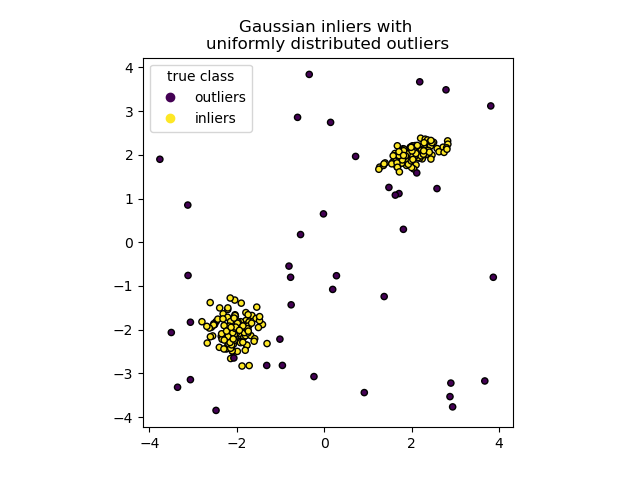
我们通过随机采样 numpy.random.randn 返回的标准正态分布来生成两个簇(每个簇包含 n_samples)。其中一个簇是球形的,另一个簇略微变形。
为了与 IsolationForest 的表示法保持一致,正常值(即高斯簇)被赋予地面真值标签 1,而离群值(使用 numpy.random.uniform 创建)被赋予标签 -1。
import numpy as np

from sklearn.model_selection import train_test_split

n_samples, n_outliers = 120, 40
rng = np.random.RandomState(0)
covariance = np.array([[0.5, -0.1], [0.7, 0.4]])
cluster_1 = 0.4 * rng.randn(n_samples, 2) @ covariance + np.array([2, 2])  # general
cluster_2 = 0.3 * rng.randn(n_samples, 2) + np.array([-2, -2])  # spherical
outliers = rng.uniform(low=-4, high=4, size=(n_outliers, 2))

X = np.concatenate([cluster_1, cluster_2, outliers])
y = np.concatenate(
    [np.ones((2 * n_samples), dtype=int), -np.ones((n_outliers), dtype=int)]
)

X_train, X_test, y_train, y_test = train_test_split(X, y, stratify=y, random_state=42)
我们可以可视化生成的簇
import matplotlib.pyplot as plt

scatter = plt.scatter(X[:, 0], X[:, 1], c=y, s=20, edgecolor="k")
handles, labels = scatter.legend_elements()
plt.axis("square")
plt.legend(handles=handles, labels=["outliers", "inliers"], title="true class")
plt.title("Gaussian inliers with \nuniformly distributed outliers")
plt.show()
模型训练#
from sklearn.ensemble import IsolationForest

clf = IsolationForest(max_samples=100, random_state=0)
clf.fit(X_train)
绘制离散决策边界#
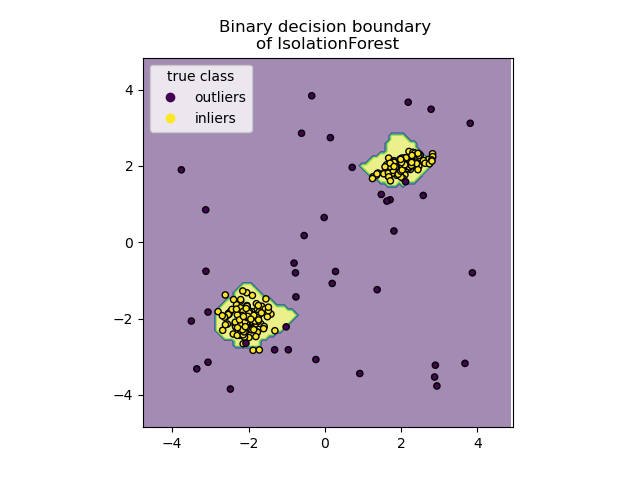
我们使用类 DecisionBoundaryDisplay 来可视化离散决策边界。背景颜色表示该给定区域中的样本是否被预测为离群值。散点图显示真实的标签。
import matplotlib.pyplot as plt

from sklearn.inspection import DecisionBoundaryDisplay

disp = DecisionBoundaryDisplay.from_estimator(
    clf,
    X,
    response_method="predict",
    alpha=0.5,
)
disp.ax_.scatter(X[:, 0], X[:, 1], c=y, s=20, edgecolor="k")
disp.ax_.set_title("Binary decision boundary \nof IsolationForest")
plt.axis("square")
plt.legend(handles=handles, labels=["outliers", "inliers"], title="true class")
plt.show()
绘制路径长度决策边界#
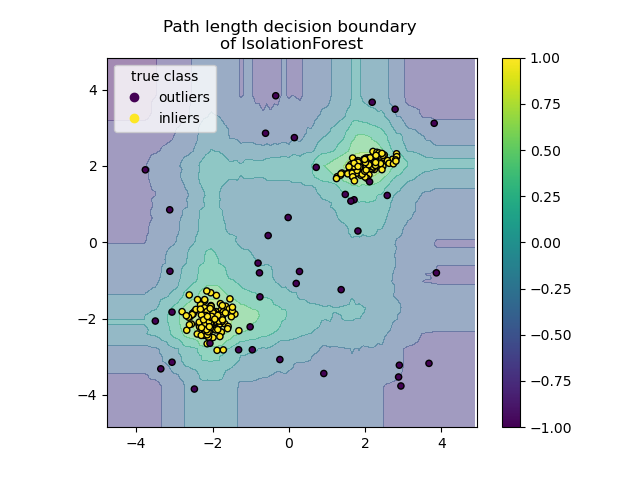
通过设置 response_method="decision_function",DecisionBoundaryDisplay 的背景表示观测值的正常性度量。这个分数由在随机树森林中平均的路径长度给出,路径长度本身由隔离给定样本所需的叶子深度(或等效于分裂次数)给出。
当随机树森林集体为隔离某些特定样本产生短路径长度时,它们极有可能是异常值,正常性度量接近 0。同样,长路径对应于接近 1 的值,并且更可能是正常值。
disp = DecisionBoundaryDisplay.from_estimator(
    clf,
    X,
    response_method="decision_function",
    alpha=0.5,
)
disp.ax_.scatter(X[:, 0], X[:, 1], c=y, s=20, edgecolor="k")
disp.ax_.set_title("Path length decision boundary \nof IsolationForest")
plt.axis("square")
plt.legend(handles=handles, labels=["outliers", "inliers"], title="true class")
plt.colorbar(disp.ax_.collections[1])
plt.show()
脚本总运行时间: (0 分钟 0.413 秒)


相关示例