注意
转到末尾以下载完整示例代码或通过 JupyterLite 或 Binder 在浏览器中运行此示例。
使用特征脸和 SVMs 进行人脸识别示例#
此示例中使用的数据集是“Labeled Faces in the Wild”(LFW)的预处理摘录,即:https://www.kaggle.com/datasets/jessicali9530/lfw-dataset
# Authors: The scikit-learn developers
# SPDX-License-Identifier: BSD-3-Clause
from time import time

import matplotlib.pyplot as plt
from scipy.stats import loguniform

from sklearn.datasets import fetch_lfw_people
from sklearn.decomposition import PCA
from sklearn.metrics import ConfusionMatrixDisplay, classification_report
from sklearn.model_selection import RandomizedSearchCV, train_test_split
from sklearn.preprocessing import StandardScaler
from sklearn.svm import SVC
下载数据(如果尚未在磁盘上)并将其加载为 numpy 数组
lfw_people = fetch_lfw_people(min_faces_per_person=70, resize=0.4)

# introspect the images arrays to find the shapes (for plotting)
n_samples, h, w = lfw_people.images.shape

# for machine learning we use the 2 data directly (as relative pixel
# positions info is ignored by this model)
X = lfw_people.data
n_features = X.shape[1]

# the label to predict is the id of the person
y = lfw_people.target
target_names = lfw_people.target_names
n_classes = target_names.shape[0]

print("Total dataset size:")
print("n_samples: %d" % n_samples)
print("n_features: %d" % n_features)
print("n_classes: %d" % n_classes)
Total dataset size:
n_samples: 1288
n_features: 1850
n_classes: 7
拆分为训练集和测试集,保留 25% 的数据用于测试。
X_train, X_test, y_train, y_test = train_test_split(
    X, y, test_size=0.25, random_state=42
)

scaler = StandardScaler()
X_train = scaler.fit_transform(X_train)
X_test = scaler.transform(X_test)
对人脸数据集(视为无标签数据集)计算 PCA(特征脸):无监督特征提取/降维
n_components = 150

print(
    "Extracting the top %d eigenfaces from %d faces" % (n_components, X_train.shape[0])
)
t0 = time()
pca = PCA(n_components=n_components, svd_solver="randomized", whiten=True).fit(X_train)
print("done in %0.3fs" % (time() - t0))

eigenfaces = pca.components_.reshape((n_components, h, w))

print("Projecting the input data on the eigenfaces orthonormal basis")
t0 = time()
X_train_pca = pca.transform(X_train)
X_test_pca = pca.transform(X_test)
print("done in %0.3fs" % (time() - t0))
Extracting the top 150 eigenfaces from 966 faces
done in 0.081s
Projecting the input data on the eigenfaces orthonormal basis
done in 0.006s
训练 SVM 分类模型
print("Fitting the classifier to the training set")
t0 = time()
param_grid = {
    "C": loguniform(1e3, 1e5),
    "gamma": loguniform(1e-4, 1e-1),
}
clf = RandomizedSearchCV(
    SVC(kernel="rbf", class_weight="balanced"), param_grid, n_iter=10
)
clf = clf.fit(X_train_pca, y_train)
print("done in %0.3fs" % (time() - t0))
print("Best estimator found by grid search:")
print(clf.best_estimator_)
Fitting the classifier to the training set
done in 5.309s
Best estimator found by grid search:
SVC(C=np.float64(76823.03433306457), class_weight='balanced',
    gamma=np.float64(0.0034189458230957995))
对测试集上的模型质量进行定量评估
print("Predicting people's names on the test set")
t0 = time()
y_pred = clf.predict(X_test_pca)
print("done in %0.3fs" % (time() - t0))

print(classification_report(y_test, y_pred, target_names=target_names))
ConfusionMatrixDisplay.from_estimator(
    clf, X_test_pca, y_test, display_labels=target_names, xticks_rotation="vertical"
)
plt.tight_layout()
plt.show()
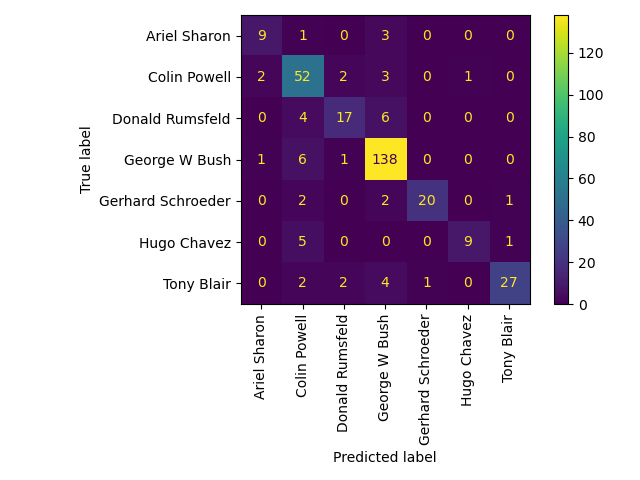
Predicting people's names on the test set
done in 0.045s
                   precision    recall  f1-score   support

     Ariel Sharon       0.75      0.69      0.72        13
     Colin Powell       0.72      0.87      0.79        60
  Donald Rumsfeld       0.77      0.63      0.69        27
    George W Bush       0.88      0.95      0.91       146
Gerhard Schroeder       0.95      0.80      0.87        25
      Hugo Chavez       0.90      0.60      0.72        15
       Tony Blair       0.93      0.75      0.83        36

         accuracy                           0.84       322
        macro avg       0.84      0.75      0.79       322
     weighted avg       0.85      0.84      0.84       322
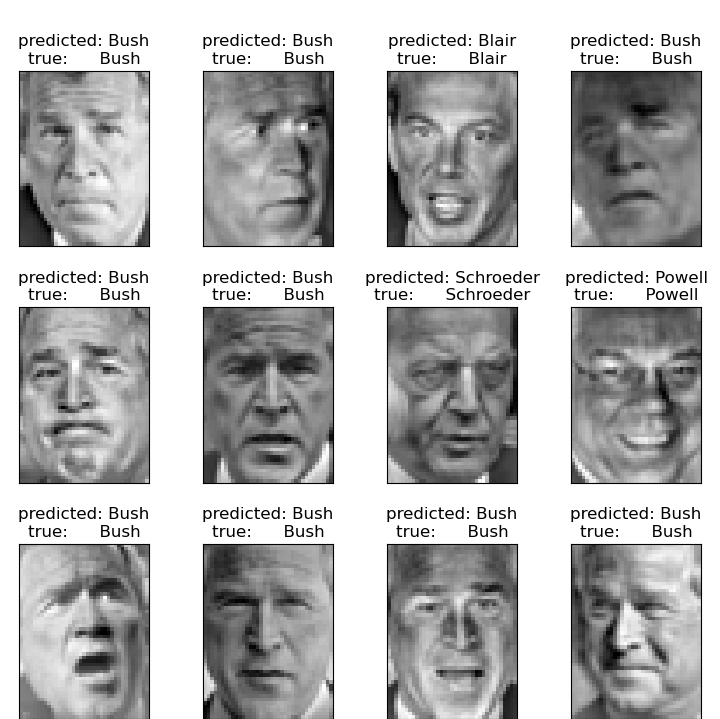
使用 matplotlib 对预测进行定性评估
def plot_gallery(images, titles, h, w, n_row=3, n_col=4):
    """Helper function to plot a gallery of portraits"""
    plt.figure(figsize=(1.8 * n_col, 2.4 * n_row))
    plt.subplots_adjust(bottom=0, left=0.01, right=0.99, top=0.90, hspace=0.35)
    for i in range(n_row * n_col):
        plt.subplot(n_row, n_col, i + 1)
        plt.imshow(images[i].reshape((h, w)), cmap=plt.cm.gray)
        plt.title(titles[i], size=12)
        plt.xticks(())
        plt.yticks(())
在测试集的一部分上绘制预测结果
def title(y_pred, y_test, target_names, i):
    pred_name = target_names[y_pred[i]].rsplit(" ", 1)[-1]
    true_name = target_names[y_test[i]].rsplit(" ", 1)[-1]
    return "predicted: %s\ntrue:      %s" % (pred_name, true_name)


prediction_titles = [
    title(y_pred, y_test, target_names, i) for i in range(y_pred.shape[0])
]

plot_gallery(X_test, prediction_titles, h, w)
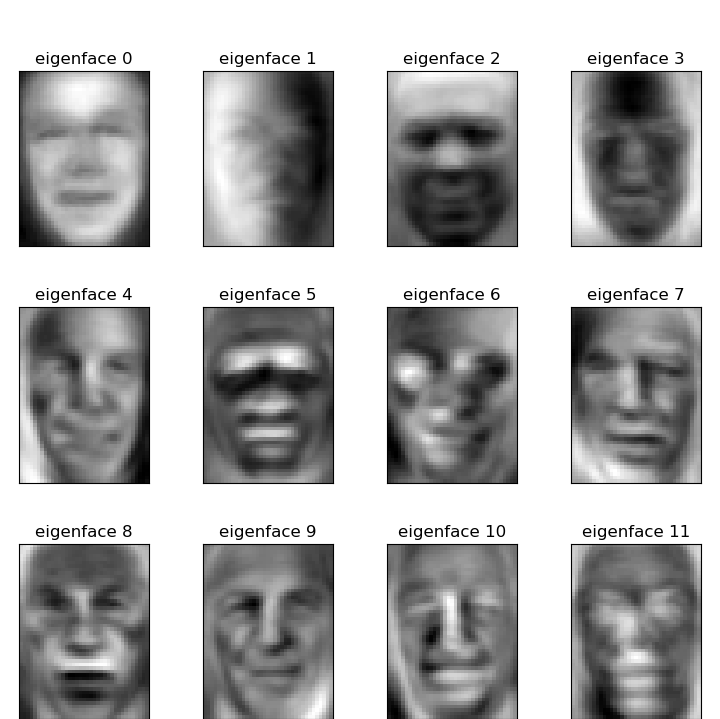
绘制最具代表性的特征脸图库
eigenface_titles = ["eigenface %d" % i for i in range(eigenfaces.shape[0])]
plot_gallery(eigenfaces, eigenface_titles, h, w)

plt.show()
人脸识别问题可以通过训练卷积神经网络得到更有效的解决,但这类模型超出了 scikit-learn 库的范围。感兴趣的读者应该转而尝试使用 pytorch 或 tensorflow 来实现此类模型。
脚本总运行时间: (0 minutes 6.002 seconds)


相关示例