注意
转到末尾以下载完整示例代码,或通过JupyterLite或Binder在浏览器中运行此示例。
在鸢尾花数据集上绘制不同的SVM分类器#
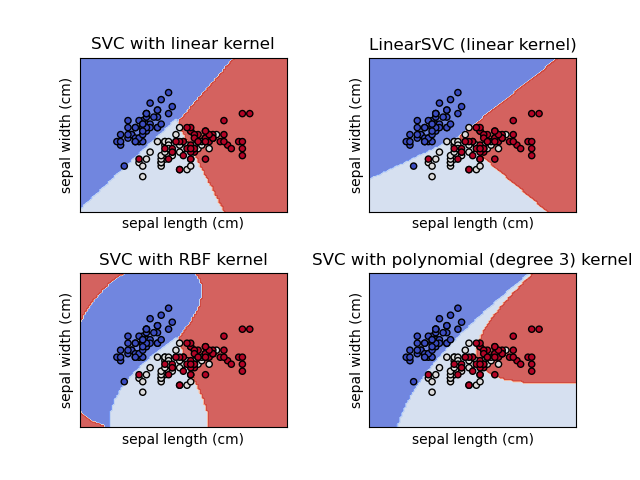
在鸢尾花数据集的2D投影上比较不同的线性SVM分类器。我们只考虑此数据集的前2个特征
萼片长度
萼片宽度
此示例演示如何绘制具有不同核的四个SVM分类器的决策面。
线性模型 LinearSVC() 和 SVC(kernel='linear') 会产生略微不同的决策边界。这可能是由于以下差异造成的:
LinearSVC最小化平方合页损失(squared hinge loss),而SVC最小化正则合页损失(regular hinge loss)。LinearSVC使用“一对多”(One-vs-All,也称为One-vs-Rest)多类别归约,而SVC使用“一对一”(One-vs-One)多类别归约。
两种线性模型都具有线性决策边界(相交的超平面),而非线性核模型(多项式或高斯RBF)具有更灵活的非线性决策边界,其形状取决于核的类型及其参数。
注意
虽然为玩具2D数据集绘制分类器的决策函数有助于直观理解它们各自的表达能力,但请注意,这些直觉并不总是能推广到更现实的高维问题。
# Authors: The scikit-learn developers
# SPDX-License-Identifier: BSD-3-Clause

import matplotlib.pyplot as plt

from sklearn import datasets, svm
from sklearn.inspection import DecisionBoundaryDisplay

# import some data to play with
iris = datasets.load_iris()
# Take the first two features. We could avoid this by using a two-dim dataset
X = iris.data[:, :2]
y = iris.target

# we create an instance of SVM and fit out data. We do not scale our
# data since we want to plot the support vectors
C = 1.0  # SVM regularization parameter
models = (
    svm.SVC(kernel="linear", C=C),
    svm.LinearSVC(C=C, max_iter=10000),
    svm.SVC(kernel="rbf", gamma=0.7, C=C),
    svm.SVC(kernel="poly", degree=3, gamma="auto", C=C),
)
models = (clf.fit(X, y) for clf in models)

# title for the plots
titles = (
    "SVC with linear kernel",
    "LinearSVC (linear kernel)",
    "SVC with RBF kernel",
    "SVC with polynomial (degree 3) kernel",
)

# Set-up 2x2 grid for plotting.
fig, sub = plt.subplots(2, 2)
plt.subplots_adjust(wspace=0.4, hspace=0.4)

X0, X1 = X[:, 0], X[:, 1]

for clf, title, ax in zip(models, titles, sub.flatten()):
    disp = DecisionBoundaryDisplay.from_estimator(
        clf,
        X,
        response_method="predict",
        cmap=plt.cm.coolwarm,
        alpha=0.8,
        ax=ax,
        xlabel=iris.feature_names[0],
        ylabel=iris.feature_names[1],
    )
    ax.scatter(X0, X1, c=y, cmap=plt.cm.coolwarm, s=20, edgecolors="k")
    ax.set_xticks(())
    ax.set_yticks(())
    ax.set_title(title)

plt.show()
脚本总运行时间: (0 minutes 0.166 seconds)


相关示例