spectral_clustering#
- sklearn.cluster.spectral_clustering(affinity, *, n_clusters=8, n_components=None, eigen_solver=None, random_state=None, n_init=10, eigen_tol='auto', assign_labels='kmeans', verbose=False)[source]#
将聚类应用于归一化拉普拉斯算子的投影。
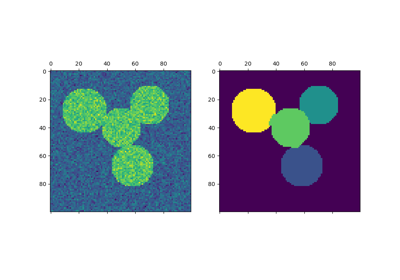
In practice Spectral Clustering is very useful when the structure of the individual clusters is highly non-convex or more generally when a measure of the center and spread of the cluster is not a suitable description of the complete cluster. For instance, when clusters are nested circles on the 2D plane.
If affinity is the adjacency matrix of a graph, this method can be used to find normalized graph cuts [1], [2].
Read more in the User Guide.
- 参数:
- affinity{array-like, sparse matrix} of shape (n_samples, n_samples)
The affinity matrix describing the relationship of the samples to embed. Must be symmetric.
- Possible examples
adjacency matrix of a graph,
heat kernel of the pairwise distance matrix of the samples,
symmetric k-nearest neighbours connectivity matrix of the samples.
- n_clustersint, default=None
Number of clusters to extract.
- n_componentsint, default=n_clusters
Number of eigenvectors to use for the spectral embedding.
- eigen_solver{None, ‘arpack’, ‘lobpcg’, or ‘amg’}
The eigenvalue decomposition method. If None then
'arpack'is used. See [4] for more details regarding'lobpcg'. Eigensolver'amg'runs'lobpcg'with optional Algebraic MultiGrid preconditioning and requires pyamg to be installed. It can be faster on very large sparse problems [6] and [7].- random_stateint, RandomState instance, default=None
A pseudo random number generator used for the initialization of the lobpcg eigenvectors decomposition when
eigen_solver == 'amg', and for the K-Means initialization. Use an int to make the results deterministic across calls (See Glossary).注意
用于初始化 lobpcg 特征向量分解的伪随机数生成器,当
eigen_solver == 'amg'时,以及用于 K-Means 初始化。使用整数使结果在多次调用中具有确定性(请参阅 词汇表)。- n_initint, default=10
Number of time the k-means algorithm will be run with different centroid seeds. The final results will be the best output of n_init consecutive runs in terms of inertia. Only used if
assign_labels='kmeans'.- 使用最近邻方法构造亲和力矩阵时要使用的邻居数。对于
affinity='rbf',将被忽略。 Stopping criterion for eigendecomposition of the Laplacian matrix. If
eigen_tol="auto"then the passed tolerance will depend on theeigen_solver拉普拉斯矩阵特征分解的停止准则。如果
eigen_tol="auto",则传递的容差将取决于eigen_solver如果
eigen_solver="arpack",则eigen_tol=0.0;
如果
eigen_solver="lobpcg"或eigen_solver="amg",则eigen_tol=None,它将配置底层lobpcg求解器根据其启发式方法自动解析值。有关详细信息,请参阅scipy.sparse.linalg.lobpcg。请注意,当使用
eigen_solver="lobpcg"或eigen_solver="amg"时,tol<1e-5的值可能导致收敛问题,应避免使用。- assign_labels{‘kmeans’, ‘discretize’, ‘cluster_qr’}, default=’kmeans’
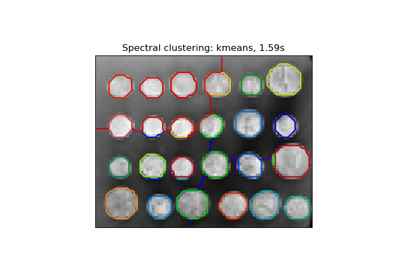
The strategy to use to assign labels in the embedding space. There are three ways to assign labels after the Laplacian embedding. k-means can be applied and is a popular choice. But it can also be sensitive to initialization. Discretization is another approach which is less sensitive to random initialization [3]. The cluster_qr method [5] directly extracts clusters from eigenvectors in spectral clustering. In contrast to k-means and discretization, cluster_qr has no tuning parameters and is not an iterative method, yet may outperform k-means and discretization in terms of both quality and speed. For a detailed comparison of clustering strategies, refer to the following example: Segmenting the picture of greek coins in regions.
Changed in version 1.1: Added new labeling method ‘cluster_qr’.
- verbosebool, default=False
Verbosity mode.
0.24 版本新增。
- 返回:
- labelsarray of integers, shape: n_samples
The labels of the clusters.
注意事项
The graph should contain only one connected component, elsewhere the results make little sense.
This algorithm solves the normalized cut for
k=2: it is a normalized spectral clustering.References
示例
>>> import numpy as np
>>> from sklearn.metrics.pairwise import pairwise_kernels
>>> from sklearn.cluster import spectral_clustering
>>> X = np.array([[1, 1], [2, 1], [1, 0],
...               [4, 7], [3, 5], [3, 6]])
>>> affinity = pairwise_kernels(X, metric='rbf')
>>> spectral_clustering(
...     affinity=affinity, n_clusters=2, assign_labels="discretize", random_state=0
... )
array([1, 1, 1, 0, 0, 0])