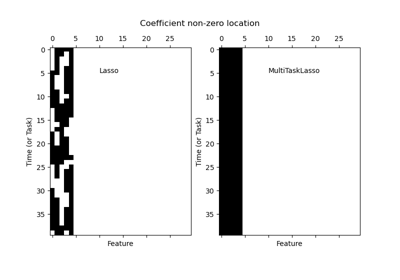
MultiTaskLasso#
- class sklearn.linear_model.MultiTaskLasso(alpha=1.0, *, fit_intercept=True, copy_X=True, max_iter=1000, tol=0.0001, warm_start=False, random_state=None, selection='cyclic')[source]#
使用 L1/L2 混合范数作为正则化项训练的多任务 Lasso 模型。
The optimization objective for Lasso is
(1 / (2 * n_samples)) * ||Y - XW||^2_Fro + alpha * ||W||_21
其中
||W||_21 = \sum_i \sqrt{\sum_j w_{ij}^2}
即每行范数之和。
在用户指南中阅读更多内容。
- 参数:
- alphafloat, default=1.0
乘以 L1/L2 项的常数。默认为 1.0。
- fit_interceptbool, default=True
Whether to calculate the intercept for this model. If set to false, no intercept will be used in calculations (i.e. data is expected to be centered).
- copy_Xbool, default=True
如果为
True,X将被复制;否则,它可能会被覆盖。- max_iterint, default=1000
最大迭代次数。
- tolfloat, default=1e-4
The tolerance for the optimization: if the updates are smaller or equal to
tol, the optimization code checks the dual gap for optimality and continues until it is smaller or equal totol.- warm_startbool, default=False
设置为
True时,将前一次调用fit的解决方案作为初始化重新使用,否则,擦除前一个解决方案。请参阅词汇表。- random_stateint, RandomState instance, default=None
选择要更新的随机特征的伪随机数生成器种子。当
selection== ‘random’时使用。传入一个整数可以在多次函数调用中获得可重现的输出。请参阅词汇表。- selection{‘cyclic’, ‘random’}, default=’cyclic’
如果设置为‘random’,则每次迭代更新一个随机系数,而不是默认按顺序遍历特征。这(设置为‘random’)通常会导致显著更快的收敛,尤其当tol高于1e-4时。
- 属性:
- coef_ndarray of shape (n_targets, n_features)
Parameter vector (W in the cost function formula). Note that
coef_stores the transpose ofW,W.T.- intercept_ndarray of shape (n_targets,)
决策函数中的独立项。
- n_iter_int
坐标下降求解器达到指定容忍度运行的迭代次数。
- dual_gap_ndarray of shape (n_alphas,)
每个alpha优化结束时的对偶间隙。
- eps_float
按目标
y的方差缩放后的容差。sparse_coef_sparse matrix of shape (n_features,) or (n_targets, n_features)拟合的
coef_的稀疏表示。- n_features_in_int
在 拟合 期间看到的特征数。
0.24 版本新增。
- feature_names_in_shape 为 (
n_features_in_,) 的 ndarray 在 fit 期间看到的特征名称。仅当
X具有全部为字符串的特征名称时才定义。1.0 版本新增。
另请参阅
Lasso使用 L1 先验作为正则化项训练的线性模型(又名 Lasso)。
MultiTaskLassoCV具有内置交叉验证的多任务 L1 正则化线性模型。
MultiTaskElasticNetCV具有内置交叉验证的多任务 L1/L2 ElasticNet。
注意事项
用于拟合模型的算法是坐标下降法。
为避免不必要的内存复制,fit 方法的 X 和 y 参数应直接作为 Fortran-contiguous numpy 数组传入。
示例
>>> from sklearn import linear_model
>>> clf = linear_model.MultiTaskLasso(alpha=0.1)
>>> clf.fit([[0, 1], [1, 2], [2, 4]], [[0, 0], [1, 1], [2, 3]])
MultiTaskLasso(alpha=0.1)
>>> print(clf.coef_)
[[0.         0.60809415]
[0.         0.94592424]]
>>> print(clf.intercept_)
[-0.41888636 -0.87382323]
- fit(X, y)[source]#
Fit MultiTaskElasticNet model with coordinate descent.
- 参数:
- Xndarray of shape (n_samples, n_features)
数据。
- yndarray of shape (n_samples, n_targets)
目标。如果需要,将被转换为X的数据类型。
- 返回:
- selfobject
拟合的估计器。
注意事项
坐标下降是一种一次考虑一列数据的算法,因此在必要时会自动将X输入转换为Fortran连续的numpy数组。
为避免内存重新分配,建议直接使用该格式在内存中分配初始数据。
- get_metadata_routing()[source]#
获取此对象的元数据路由。
请查阅 用户指南,了解路由机制如何工作。
- 返回:
- routingMetadataRequest
封装路由信息的
MetadataRequest。
- get_params(deep=True)[source]#
获取此估计器的参数。
- 参数:
- deepbool, default=True
如果为 True,将返回此估计器以及包含的子对象(如果它们是估计器)的参数。
- 返回:
- paramsdict
参数名称映射到其值。
- static path(X, y, *, l1_ratio=0.5, eps=0.001, n_alphas=100, alphas=None, precompute='auto', Xy=None, copy_X=True, coef_init=None, verbose=False, return_n_iter=False, positive=False, check_input=True, **params)[source]#
使用坐标下降计算 elastic net 路径。
弹性网络优化函数对于单输出和多输出任务有所不同。
对于单输出任务,它是
1 / (2 * n_samples) * ||y - Xw||^2_2
+ alpha * l1_ratio * ||w||_1
+ 0.5 * alpha * (1 - l1_ratio) * ||w||^2_2
对于多输出任务,它是
(1 / (2 * n_samples)) * ||Y - XW||_Fro^2
+ alpha * l1_ratio * ||W||_21
+ 0.5 * alpha * (1 - l1_ratio) * ||W||_Fro^2
其中
||W||_21 = \sum_i \sqrt{\sum_j w_{ij}^2}
即每行范数之和。
在用户指南中阅读更多内容。
- 参数:
- Xshape 为 (n_samples, n_features) 的 {array-like, sparse matrix}
训练数据。直接作为Fortran连续数据传递以避免不必要的内存复制。如果
y是单输出,则X可以是稀疏的。- y{array-like, sparse matrix} of shape (n_samples,) or (n_samples, n_targets)
目标值。
- l1_ratiofloat, default=0.5
传递给弹性网络的值介于0和1之间(L1和L2惩罚之间的缩放)。
l1_ratio=1对应于Lasso。- epsfloat, default=1e-3
路径的长度。
eps=1e-3表示alpha_min / alpha_max = 1e-3。- n_alphasint, default=100
正则化路径上alpha的数量。
- alphasarray-like, default=None
计算模型的alpha列表。如果为None,则自动设置alphas。
- precompute‘auto’, bool or array-like of shape (n_features, n_features), default=’auto’
是否使用预计算的Gram矩阵来加快计算速度。如果设置为
'auto',则由我们决定。Gram矩阵也可以作为参数传入。- Xyarray-like of shape (n_features,) or (n_features, n_targets), default=None
可以预计算的Xy = np.dot(X.T, y)。仅当Gram矩阵预计算时有用。
- copy_Xbool, default=True
如果为
True,X将被复制;否则,它可能会被覆盖。- coef_initarray-like of shape (n_features, ), default=None
系数的初始值。
- verbosebool or int, default=False
冗余度级别。
- return_n_iterbool, default=False
是否返回迭代次数。
- positivebool, default=False
如果设置为True,强制系数为正。(仅当
y.ndim == 1时允许)。- check_inputbool, default=True
如果设置为False,则跳过输入验证检查(包括提供的Gram矩阵)。假设这些检查由调用者处理。
- **paramskwargs
传递给坐标下降求解器的关键字参数。
- 返回:
- alphasndarray of shape (n_alphas,)
计算模型的路径上的alphas。
- coefsndarray of shape (n_features, n_alphas) or (n_targets, n_features, n_alphas)
路径上的系数。
- dual_gapsndarray of shape (n_alphas,)
每个alpha优化结束时的对偶间隙。
- n_iterslist of int
坐标下降优化器为达到每个alpha的指定容忍度所花费的迭代次数。(当
return_n_iter设置为True时返回)。
另请参阅
MultiTaskElasticNet使用 L1/L2 混合范数作为正则化项训练的多任务 ElasticNet 模型。
MultiTaskElasticNetCV具有内置交叉验证的多任务 L1/L2 ElasticNet。
ElasticNet具有组合 L1 和 L2 先验作为正则化项的线性回归。
ElasticNetCV具有沿正则化路径迭代拟合的 Elastic Net 模型。
注意事项
有关示例,请参阅examples/linear_model/plot_lasso_lasso_lars_elasticnet_path.py。
底层的坐标下降求解器使用间隙安全筛选规则来加快拟合时间,请参阅坐标下降用户指南。
示例
>>> from sklearn.linear_model import enet_path
>>> from sklearn.datasets import make_regression
>>> X, y, true_coef = make_regression(
...    n_samples=100, n_features=5, n_informative=2, coef=True, random_state=0
... )
>>> true_coef
array([ 0.        ,  0.        ,  0.        , 97.9, 45.7])
>>> alphas, estimated_coef, _ = enet_path(X, y, n_alphas=3)
>>> alphas.shape
(3,)
>>> estimated_coef
 array([[ 0.,  0.787,  0.568],
        [ 0.,  1.120,  0.620],
        [-0., -2.129, -1.128],
        [ 0., 23.046, 88.939],
        [ 0., 10.637, 41.566]])
- predict(X)[source]#
使用线性模型进行预测。
- 参数:
- Xarray-like or sparse matrix, shape (n_samples, n_features)
样本。
- 返回:
- Carray, shape (n_samples,)
返回预测值。
- score(X, y, sample_weight=None)[source]#
返回测试数据的 决定系数。
决定系数 \(R^2\) 定义为 \((1 - \frac{u}{v})\),其中 \(u\) 是残差平方和
((y_true - y_pred)** 2).sum(),\(v\) 是总平方和((y_true - y_true.mean()) ** 2).sum()。最佳得分为 1.0,得分也可能为负(因为模型可能任意地差)。一个总是预测y期望值,忽略输入特征的常数模型将获得 \(R^2\) 得分 0.0。- 参数:
- Xshape 为 (n_samples, n_features) 的 array-like
测试样本。对于某些估计器,这可能是一个预先计算的核矩阵或一个通用对象列表,形状为
(n_samples, n_samples_fitted),其中n_samples_fitted是用于估计器拟合的样本数。- yshape 为 (n_samples,) 或 (n_samples, n_outputs) 的 array-like
X的真实值。- sample_weightshape 为 (n_samples,) 的 array-like, default=None
样本权重。
- 返回:
- scorefloat
self.predict(X)相对于y的 \(R^2\)。
注意事项
在 0.23 版本中,对回归器调用
score时使用的 \(R^2\) 得分使用multioutput='uniform_average',以与r2_score的默认值保持一致。这会影响所有多输出回归器(MultiOutputRegressor除外)的score方法。
- set_fit_request(*, sample_weight: bool | None | str = '$UNCHANGED$') MultiTaskLasso[source]#
配置是否应请求元数据以传递给
fit方法。请注意,此方法仅在以下情况下相关:此估计器用作 元估计器 中的子估计器,并且通过
enable_metadata_routing=True启用了元数据路由(请参阅sklearn.set_config)。请查看 用户指南 以了解路由机制的工作原理。每个参数的选项如下:
True:请求元数据,如果提供则传递给fit。如果未提供元数据,则忽略该请求。False:不请求元数据,元估计器不会将其传递给fit。None:不请求元数据,如果用户提供元数据,元估计器将引发错误。str:应将元数据以给定别名而不是原始名称传递给元估计器。
默认值 (
sklearn.utils.metadata_routing.UNCHANGED) 保留现有请求。这允许您更改某些参数的请求而不更改其他参数。在版本 1.3 中新增。
- 参数:
- sample_weightstr, True, False, or None, default=sklearn.utils.metadata_routing.UNCHANGED
fit方法中sample_weight参数的元数据路由。
- 返回:
- selfobject
更新后的对象。
- set_params(**params)[source]#
设置此估计器的参数。
此方法适用于简单的估计器以及嵌套对象(如
Pipeline)。后者具有<component>__<parameter>形式的参数,以便可以更新嵌套对象的每个组件。- 参数:
- **paramsdict
估计器参数。
- 返回:
- selfestimator instance
估计器实例。
- set_score_request(*, sample_weight: bool | None | str = '$UNCHANGED$') MultiTaskLasso[source]#
配置是否应请求元数据以传递给
score方法。请注意,此方法仅在以下情况下相关:此估计器用作 元估计器 中的子估计器,并且通过
enable_metadata_routing=True启用了元数据路由(请参阅sklearn.set_config)。请查看 用户指南 以了解路由机制的工作原理。每个参数的选项如下:
True:请求元数据,如果提供则传递给score。如果未提供元数据,则忽略该请求。False:不请求元数据,元估计器不会将其传递给score。None:不请求元数据,如果用户提供元数据,元估计器将引发错误。str:应将元数据以给定别名而不是原始名称传递给元估计器。
默认值 (
sklearn.utils.metadata_routing.UNCHANGED) 保留现有请求。这允许您更改某些参数的请求而不更改其他参数。在版本 1.3 中新增。
- 参数:
- sample_weightstr, True, False, or None, default=sklearn.utils.metadata_routing.UNCHANGED
score方法中sample_weight参数的元数据路由。
- 返回:
- selfobject
更新后的对象。