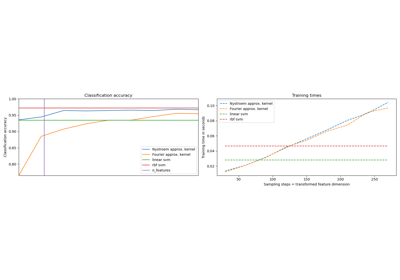
RBFSampler#
- class sklearn.kernel_approximation.RBFSampler(*, gamma=1.0, n_components=100, random_state=None)[source]#
使用随机傅里叶特征近似 RBF 核特征图。
It implements a variant of Random Kitchen Sinks.[1]
Read more in the User Guide.
- 参数:
- gamma‘scale’ or float, default=1.0
Parameter of RBF kernel: exp(-gamma * x^2). If
gamma='scale'is passed then it uses 1 / (n_features * X.var()) as value of gamma.Added in version 1.2: The option
"scale"was added in 1.2.- n_componentsint, default=100
Number of Monte Carlo samples per original feature. Equals the dimensionality of the computed feature space.
- random_stateint, RandomState instance or None, default=None
Pseudo-random number generator to control the generation of the random weights and random offset when fitting the training data. Pass an int for reproducible output across multiple function calls. See Glossary.
- 属性:
- random_offset_ndarray of shape (n_components,), dtype={np.float64, np.float32}
Random offset used to compute the projection in the
n_componentsdimensions of the feature space.- random_weights_ndarray of shape (n_features, n_components), dtype={np.float64, np.float32}
Random projection directions drawn from the Fourier transform of the RBF kernel.
- n_features_in_int
在 拟合 期间看到的特征数。
0.24 版本新增。
- feature_names_in_shape 为 (
n_features_in_,) 的 ndarray 在 fit 期间看到的特征名称。仅当
X具有全部为字符串的特征名称时才定义。1.0 版本新增。
另请参阅
AdditiveChi2Sampler加性卡方核的近似特征图。
Nystroem使用训练数据的子集近似核图。
PolynomialCountSketch通过张量草图近似多项式核。
SkewedChi2Sampler“偏斜卡方”核的近似特征图。
sklearn.metrics.pairwise.kernel_metricsList of built-in kernels.
注意事项
See “Random Features for Large-Scale Kernel Machines” by A. Rahimi and Benjamin Recht.
[1] “Weighted Sums of Random Kitchen Sinks: Replacing minimization with randomization in learning” by A. Rahimi and Benjamin Recht. (https://people.eecs.berkeley.edu/~brecht/papers/08.rah.rec.nips.pdf)
示例
>>> from sklearn.kernel_approximation import RBFSampler
>>> from sklearn.linear_model import SGDClassifier
>>> X = [[0, 0], [1, 1], [1, 0], [0, 1]]
>>> y = [0, 0, 1, 1]
>>> rbf_feature = RBFSampler(gamma=1, random_state=1)
>>> X_features = rbf_feature.fit_transform(X)
>>> clf = SGDClassifier(max_iter=5, tol=1e-3)
>>> clf.fit(X_features, y)
SGDClassifier(max_iter=5)
>>> clf.score(X_features, y)
1.0
- fit(X, y=None)[source]#
使用 X 拟合模型。
Samples random projection according to n_features.
- 参数:
- X{array-like, sparse matrix}, shape (n_samples, n_features)
训练数据,其中
n_samples是样本数,n_features是特征数。- yarray-like, shape (n_samples,) or (n_samples, n_outputs), default=None
目标值(对于无监督转换,为 None)。
- 返回:
- selfobject
返回实例本身。
- fit_transform(X, y=None, **fit_params)[source]#
拟合数据,然后对其进行转换。
使用可选参数
fit_params将转换器拟合到X和y,并返回X的转换版本。- 参数:
- Xshape 为 (n_samples, n_features) 的 array-like
输入样本。
- y形状为 (n_samples,) 或 (n_samples, n_outputs) 的类数组对象,默认=None
目标值(对于无监督转换,为 None)。
- **fit_paramsdict
额外的拟合参数。仅当估计器在其
fit方法中接受额外的参数时才传递。
- 返回:
- X_newndarray array of shape (n_samples, n_features_new)
转换后的数组。
- get_feature_names_out(input_features=None)[source]#
获取转换的输出特征名称。
The feature names out will prefixed by the lowercased class name. For example, if the transformer outputs 3 features, then the feature names out are:
["class_name0", "class_name1", "class_name2"].- 参数:
- input_featuresarray-like of str or None, default=None
Only used to validate feature names with the names seen in
fit.
- 返回:
- feature_names_outstr 对象的 ndarray
转换后的特征名称。
- get_metadata_routing()[source]#
获取此对象的元数据路由。
请查阅 用户指南,了解路由机制如何工作。
- 返回:
- routingMetadataRequest
封装路由信息的
MetadataRequest。
- get_params(deep=True)[source]#
获取此估计器的参数。
- 参数:
- deepbool, default=True
如果为 True,将返回此估计器以及包含的子对象(如果它们是估计器)的参数。
- 返回:
- paramsdict
参数名称映射到其值。
- set_output(*, transform=None)[source]#
设置输出容器。
有关如何使用 API 的示例,请参阅引入 set_output API。
- 参数:
- transform{“default”, “pandas”, “polars”}, default=None
配置
transform和fit_transform的输出。"default": 转换器的默认输出格式"pandas": DataFrame 输出"polars": Polars 输出None: 转换配置保持不变
1.4 版本新增: 添加了
"polars"选项。
- 返回:
- selfestimator instance
估计器实例。