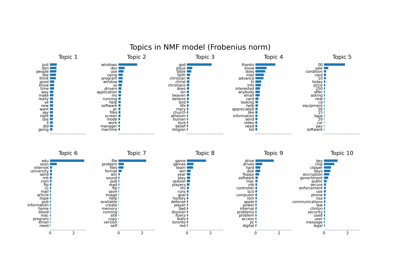
LatentDirichletAllocation#
- class sklearn.decomposition.LatentDirichletAllocation(n_components=10, *, doc_topic_prior=None, topic_word_prior=None, learning_method='batch', learning_decay=0.7, learning_offset=10.0, max_iter=10, batch_size=128, evaluate_every=-1, total_samples=1000000.0, perp_tol=0.1, mean_change_tol=0.001, max_doc_update_iter=100, n_jobs=None, verbose=0, random_state=None)[source]#
使用在线变分贝叶斯算法的潜在狄利克雷分配。
版本0.17中新增。
在 用户指南 中阅读更多内容。
- 参数:
- n_componentsint, default=10
主题数。
版本 0.19 中的变更:
n_topics已重命名为n_components- doc_topic_priorfloat, default=None
文档主题分布
theta的先验。如果值为 None,则默认为1 / n_components。在 [1] 中,这被称为alpha。- topic_word_priorfloat, default=None
主题词分布
beta的先验。如果值为 None,则默认为1 / n_components。在 [1] 中,这被称为eta。- learning_method{‘batch’, ‘online’}, default=’batch’
用于更新
_component的方法。仅在fit方法中使用。通常,如果数据量很大,在线更新会比批量更新快得多。有效选项
‘batch’:批量变分贝叶斯方法。在每次 EM 更新中使用所有训练数据。旧的
components_在每次迭代中都会被覆盖。‘online’:在线变分贝叶斯方法。在每次 EM 更新中,使用小批量训练数据增量更新
components_变量。学习率由learning_decay和learning_offset参数控制。
版本 0.20 中的变更: 默认学习方法现在是
"batch"。- learning_decayfloat, default=0.7
这是一个控制在线学习方法中学习率的参数。为了保证渐近收敛,该值应设置在 (0.5, 1.0] 之间。当值为 0.0 且 batch_size 为
n_samples时,更新方法与批量学习相同。在文献中,这被称为 kappa。- learning_offsetfloat, default=10.0
一个(正)参数,用于在线学习中降低早期迭代的权重。它应该大于 1.0。在文献中,这被称为 tau_0。
- max_iterint, default=10
对训练数据的最大遍历次数(也称为 epoch)。它只影响
fit方法的行为,而不影响partial_fit方法。- batch_sizeint, default=128
每次 EM 迭代中使用的文档数。仅用于在线学习。
- evaluate_everyint, default=-1
评估困惑度的频率。仅在
fit方法中使用。设置为 0 或负数表示在训练过程中完全不评估困惑度。评估困惑度有助于检查训练过程中的收敛性,但也会增加总训练时间。在每次迭代中评估困惑度可能会使训练时间增加一倍。- total_samplesint, default=1e6
文档总数。仅在
partial_fit方法中使用。- perp_tolfloat, default=1e-1
困惑度容差。仅当
evaluate_every大于 0 时使用。- mean_change_tolfloat, default=1e-3
E 步中更新文档主题分布的停止容差。
- max_doc_update_iterint, default=100
E 步中更新文档主题分布的最大迭代次数。
- n_jobsint, default=None
用于 E 步的作业数。
None表示 1,除非在joblib.parallel_backend上下文中。-1表示使用所有处理器。有关更多详细信息,请参阅 词汇表。- verboseint, default=0
详细程度。
- random_stateint, RandomState instance or None, default=None
传入一个整数,以便在多次函数调用中获得可重现的结果。请参阅 词汇表。
- 属性:
- components_ndarray of shape (n_components, n_features)
主题词分布的变分参数。由于主题词分布的完全条件是 Dirichlet 分布,
components_[i, j]可以看作是伪计数,表示词j被分配给主题i的次数。它也可以看作是每个主题的词分布,经过归一化后:model.components_ / model.components_.sum(axis=1)[:, np.newaxis]。- exp_dirichlet_component_shape 为 (n_components, n_features) 的 ndarray
log 主题词分布期望值的指数值。在文献中,这被称为
exp(E[log(beta)])。- n_batch_iter_int
EM 步骤的迭代次数。
- n_features_in_int
在 拟合 期间看到的特征数。
0.24 版本新增。
- feature_names_in_shape 为 (
n_features_in_,) 的 ndarray 在 fit 期间看到的特征名称。仅当
X具有全部为字符串的特征名称时才定义。1.0 版本新增。
- n_iter_int
数据集的遍历次数。
- bound_float
训练集上的最终困惑度得分。
- doc_topic_prior_float
文档主题分布
theta的先验。如果值为 None,则为1 / n_components。- random_state_RandomState instance
从种子、随机数生成器或
np.random生成的 RandomState 实例。- topic_word_prior_float
主题词分布
beta的先验。如果值为 None,则为1 / n_components。
另请参阅
sklearn.discriminant_analysis.LinearDiscriminantAnalysis一个具有线性决策边界的分类器,通过将类别条件密度拟合到数据并使用贝叶斯规则生成。
References
[1] (1,2,3)“Online Learning for Latent Dirichlet Allocation”,Matthew D. Hoffman, David M. Blei, Francis Bach, 2010。blei-lab/onlineldavb
[2]“Stochastic Variational Inference”,Matthew D. Hoffman, David M. Blei, Chong Wang, John Paisley, 2013。https://jmlr.org/papers/volume14/hoffman13a/hoffman13a.pdf
示例
>>> from sklearn.decomposition import LatentDirichletAllocation
>>> from sklearn.datasets import make_multilabel_classification
>>> # This produces a feature matrix of token counts, similar to what
>>> # CountVectorizer would produce on text.
>>> X, _ = make_multilabel_classification(random_state=0)
>>> lda = LatentDirichletAllocation(n_components=5,
...     random_state=0)
>>> lda.fit(X)
LatentDirichletAllocation(...)
>>> # get topics for some given samples:
>>> lda.transform(X[-2:])
array([[0.00360392, 0.25499205, 0.0036211 , 0.64236448, 0.09541846],
       [0.15297572, 0.00362644, 0.44412786, 0.39568399, 0.003586  ]])
- fit(X, y=None)[source]#
使用变分贝叶斯方法为数据 X 学习模型。
当
learning_method为 ‘online’ 时,使用小批量更新。否则,使用批量更新。- 参数:
- Xshape 为 (n_samples, n_features) 的 {array-like, sparse matrix}
文档词矩阵。
- y被忽略
Not used, present here for API consistency by convention.
- 返回:
- self
拟合的估计器。
- fit_transform(X, y=None, *, normalize=True)[source]#
拟合数据,然后对其进行转换。
将转换器拟合到
X和y并返回X的转换版本。- 参数:
- Xshape 为 (n_samples, n_features) 的 array-like
输入样本。
- y形状为 (n_samples,) 或 (n_samples, n_outputs) 的类数组对象,默认=None
目标值(对于无监督转换,为 None)。
- normalizebool, default=True
是否在
transform中归一化文档主题分布。
- 返回:
- X_newshape 为 (n_samples, n_components) 的 ndarray 数组
转换后的数组。
- get_feature_names_out(input_features=None)[source]#
获取转换的输出特征名称。
The feature names out will prefixed by the lowercased class name. For example, if the transformer outputs 3 features, then the feature names out are:
["class_name0", "class_name1", "class_name2"].- 参数:
- input_featuresarray-like of str or None, default=None
Only used to validate feature names with the names seen in
fit.
- 返回:
- feature_names_outstr 对象的 ndarray
转换后的特征名称。
- get_metadata_routing()[source]#
获取此对象的元数据路由。
请查阅 用户指南,了解路由机制如何工作。
- 返回:
- routingMetadataRequest
封装路由信息的
MetadataRequest。
- get_params(deep=True)[source]#
获取此估计器的参数。
- 参数:
- deepbool, default=True
如果为 True,将返回此估计器以及包含的子对象(如果它们是估计器)的参数。
- 返回:
- paramsdict
参数名称映射到其值。
- partial_fit(X, y=None)[source]#
使用 Mini-Batch 更新进行在线 VB。
- 参数:
- Xshape 为 (n_samples, n_features) 的 {array-like, sparse matrix}
文档词矩阵。
- y被忽略
Not used, present here for API consistency by convention.
- 返回:
- self
部分拟合的估计器。
- perplexity(X, sub_sampling=False)[source]#
计算数据 X 的近似困惑度。
困惑度定义为 exp(-1. * log-likelihood per word)
版本 0.19 中的变更: doc_topic_distr 参数已被弃用并被忽略,因为用户不再能访问未归一化的分布。
- 参数:
- Xshape 为 (n_samples, n_features) 的 {array-like, sparse matrix}
文档词矩阵。
- sub_samplingbool
是否进行子采样。
- 返回:
- scorefloat
困惑度得分。
- score(X, y=None)[source]#
计算近似对数似然作为得分。
- 参数:
- Xshape 为 (n_samples, n_features) 的 {array-like, sparse matrix}
文档词矩阵。
- y被忽略
Not used, present here for API consistency by convention.
- 返回:
- scorefloat
使用近似边界作为得分。
- set_output(*, transform=None)[source]#
设置输出容器。
有关如何使用 API 的示例,请参阅引入 set_output API。
- 参数:
- transform{“default”, “pandas”, “polars”}, default=None
配置
transform和fit_transform的输出。"default": 转换器的默认输出格式"pandas": DataFrame 输出"polars": Polars 输出None: 转换配置保持不变
1.4 版本新增: 添加了
"polars"选项。
- 返回:
- selfestimator instance
估计器实例。
- set_params(**params)[source]#
设置此估计器的参数。
此方法适用于简单的估计器以及嵌套对象(如
Pipeline)。后者具有<component>__<parameter>形式的参数,以便可以更新嵌套对象的每个组件。- 参数:
- **paramsdict
估计器参数。
- 返回:
- selfestimator instance
估计器实例。
- set_transform_request(*, normalize: bool | None | str = '$UNCHANGED$') LatentDirichletAllocation[source]#
配置是否应请求元数据以传递给
transform方法。请注意,此方法仅在以下情况下相关:此估计器用作 元估计器 中的子估计器,并且通过
enable_metadata_routing=True启用了元数据路由(请参阅sklearn.set_config)。请查看 用户指南 以了解路由机制的工作原理。每个参数的选项如下:
True:请求元数据,如果提供则传递给transform。如果未提供元数据,则忽略该请求。False:不请求元数据,并且元估计器不会将其传递给transform。None:不请求元数据,如果用户提供元数据,元估计器将引发错误。str:应将元数据以给定别名而不是原始名称传递给元估计器。
默认值 (
sklearn.utils.metadata_routing.UNCHANGED) 保留现有请求。这允许您更改某些参数的请求而不更改其他参数。在版本 1.3 中新增。
- 参数:
- normalizestr, True, False, or None, default=sklearn.utils.metadata_routing.UNCHANGED
transform中normalize参数的元数据路由。
- 返回:
- selfobject
更新后的对象。