二分K均值#
- class sklearn.cluster.BisectingKMeans(n_clusters=8, *, init='random', n_init=1, random_state=None, max_iter=300, verbose=0, tol=0.0001, copy_x=True, algorithm='lloyd', bisecting_strategy='biggest_inertia')[source]#
二分K均值聚类。
详情请参阅用户指南。
版本 1.1 新增。
- 参数:
- n_clustersint, 默认值=8
要形成的簇的数量以及要生成的质心的数量。
- init{‘k-means++’, ‘random’} 或可调用对象, 默认值=’random’
初始化方法
‘k-means++’:以智能方式选择K均值聚类的初始簇中心,以加速收敛。详情请参阅k_init中的“注意”部分。
‘random’:从数据中随机选择
n_clusters个观测值(行)作为初始质心。如果传递一个可调用对象,它应该接受 X、n_clusters 和 random state 作为参数,并返回一个初始化。
- n_initint, 默认值=1
在每次二分中,内部 k-means 算法将以不同的质心种子运行的次数。这将导致每次二分都产生 n_init 次连续运行中惯性(inertia)最佳的结果。
- random_stateint, RandomState 实例或 None, 默认值=None
决定内部 K-Means 中质心初始化的随机数生成。使用整数可使随机性确定。详情请参阅词汇表。
- max_iterint, 默认值=300
每次二分中内部 k-means 算法的最大迭代次数。
- verboseint, 默认值=0
详细模式。
- tolfloat, 默认值=1e-4
两次连续迭代中簇中心差值的 Frobenius 范数相对容差,用于声明收敛。在每次二分中的内部 k-means 算法中使用,以选择最佳簇。
- copy_xbool, 默认值=True
在预计算距离时,首先对数据进行中心化在数值上更精确。如果 copy_x 为 True(默认值),则原始数据不会被修改。如果为 False,则原始数据会被修改,并在函数返回前恢复,但通过减去再加上数据均值可能会引入微小的数值差异。请注意,如果原始数据不是 C 连续的,即使 copy_x 为 False 也会创建副本。如果原始数据是稀疏的但不是 CSR 格式,即使 copy_x 为 False 也会创建副本。
- algorithm{“lloyd”, “elkan”}, 默认值=”lloyd”
二分中使用的内部 K-means 算法。经典的 EM 风格算法是
"lloyd"。"elkan"变体在某些具有明确定义簇的数据集上使用三角不等式可以更高效。然而,由于需要额外分配一个形状为(n_samples, n_clusters)的数组,它会占用更多内存。- bisecting_strategy{“biggest_inertia”, “largest_cluster”}, 默认值=”biggest_inertia”
定义二分如何执行
“biggest_inertia” 意味着 BisectingKMeans 总是检查所有已计算的簇,找出具有最大 SSE(平方误差和)的簇并对其进行二分。这种方法侧重于精度,但执行时间可能较长(特别是对于大量数据点)。
“largest_cluster” - BisectingKMeans 总是从所有先前计算的簇中,分割分配点数最多的簇。这应该比按 SSE(‘biggest_inertia’)选择更快,并且在大多数情况下可能产生相似的结果。
- 属性:
- cluster_centers_形状为 (n_clusters, n_features) 的 ndarray
簇中心的坐标。如果算法在完全收敛前停止(参见
tol和max_iter),这些坐标将与labels_不一致。- labels_形状为 (n_samples,) 的 ndarray
每个点的标签。
- inertia_浮点数
样本到其最近簇中心的平方距离之和,如果提供了样本权重则按样本权重加权。
- n_features_in_int
在拟合(fit)期间看到的特征数量。
- feature_names_in_形状为 (
n_features_in_,) 的 ndarray 在拟合(fit)期间看到的特征名称。仅当
X的所有特征名称均为字符串时才定义。
另请参见
KMeansK-Means算法的原始实现。
注意
当 n_cluster 小于 3 时,可能效率低下,因为会进行不必要的计算。
示例
>>> from sklearn.cluster import BisectingKMeans
>>> import numpy as np
>>> X = np.array([[1, 1], [10, 1], [3, 1],
...               [10, 0], [2, 1], [10, 2],
...               [10, 8], [10, 9], [10, 10]])
>>> bisect_means = BisectingKMeans(n_clusters=3, random_state=0).fit(X)
>>> bisect_means.labels_
array([0, 2, 0, 2, 0, 2, 1, 1, 1], dtype=int32)
>>> bisect_means.predict([[0, 0], [12, 3]])
array([0, 2], dtype=int32)
>>> bisect_means.cluster_centers_
array([[ 2., 1.],
       [10., 9.],
       [10., 1.]])
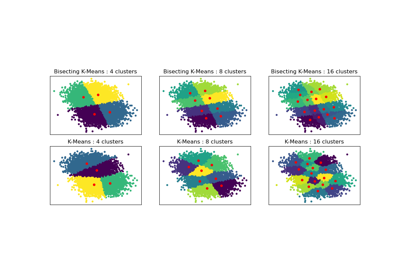
有关二分K均值和K均值之间的比较,请参阅示例二分K均值与常规K均值性能比较。
- fit(X, y=None, sample_weight=None)[source]#
计算二分 k-means 聚类。
- 参数:
- X{类数组, 稀疏矩阵} 形状为 (n_samples, n_features)
用于聚类的训练实例。
注意
数据将被转换为 C 顺序,如果给定数据不是 C 连续的,将导致内存复制。
- y已忽略
未使用,根据 API 约定在此处存在。
- sample_weight类数组,形状为 (n_samples,), 默认值=None
X 中每个观测值的权重。如果为 None,则所有观测值都被分配相同的权重。如果
init是一个可调用对象,则在初始化期间不使用sample_weight。
- 返回:
- self
拟合后的估计器。
- fit_predict(X, y=None, sample_weight=None)[source]#
计算簇中心并预测每个样本的簇索引。
便捷方法;等同于调用 fit(X) 后再调用 predict(X)。
- 参数:
- X{类数组, 稀疏矩阵} 形状为 (n_samples, n_features)
要转换的新数据。
- y已忽略
未使用,根据 API 约定在此处存在。
- sample_weight类数组,形状为 (n_samples,), 默认值=None
X 中每个观测值的权重。如果为 None,则所有观测值都被分配相同的权重。
- 返回:
- labels形状为 (n_samples,) 的 ndarray
每个样本所属簇的索引。
- fit_transform(X, y=None, sample_weight=None)[source]#
计算聚类并将 X 转换为簇距离空间。
等同于 fit(X).transform(X),但实现更高效。
- 参数:
- X{类数组, 稀疏矩阵} 形状为 (n_samples, n_features)
要转换的新数据。
- y已忽略
未使用,根据 API 约定在此处存在。
- sample_weight类数组,形状为 (n_samples,), 默认值=None
X 中每个观测值的权重。如果为 None,则所有观测值都被分配相同的权重。
- 返回:
- X_new形状为 (n_samples, n_clusters) 的 ndarray
在新空间中转换后的 X。
- get_feature_names_out(input_features=None)[source]#
获取转换的输出特征名称。
输出特征名称将以小写类名作为前缀。例如,如果转换器输出3个特征,则输出特征名称为:
["class_name0", "class_name1", "class_name2"]。- 参数:
- input_features字符串类数组或None, 默认值=None
仅用于根据
fit中看到的名称验证特征名称。
- 返回:
- feature_names_out字符串对象的 ndarray
转换后的特征名称。
- get_metadata_routing()[source]#
获取此对象的元数据路由。
请查阅用户指南,了解路由机制的工作原理。
- 返回:
- routingMetadataRequest
一个包含路由信息的
MetadataRequest对象。
- get_params(deep=True)[source]#
获取此估计器的参数。
- 参数:
- deepbool, 默认值=True
如果为 True,将返回此估计器及其包含的作为估计器的子对象的参数。
- 返回:
- params字典
参数名称与其值之间的映射。
- predict(X)[source]#
预测 X 中每个样本所属的簇。
预测是通过沿层次树向下搜索最近的叶簇来完成的。
在向量量化文献中,
cluster_centers_被称为码本,predict返回的每个值都是码本中最接近的码的索引。- 参数:
- X{类数组, 稀疏矩阵} 形状为 (n_samples, n_features)
要预测的新数据。
- 返回:
- labels形状为 (n_samples,) 的 ndarray
每个样本所属簇的索引。
- score(X, y=None, sample_weight=None)[source]#
与 X 在 K-means 目标上的值相反。
- 参数:
- X{类数组, 稀疏矩阵} 形状为 (n_samples, n_features)
新数据。
- y已忽略
未使用,根据 API 约定在此处存在。
- sample_weight类数组,形状为 (n_samples,), 默认值=None
X 中每个观测值的权重。如果为 None,则所有观测值都被分配相同的权重。
- 返回:
- score浮点数
与 X 在 K-means 目标上的值相反。
- set_fit_request(*, sample_weight: bool | None | str = '$UNCHANGED$') BisectingKMeans[source]#
请求传递给
fit方法的元数据。请注意,此方法仅在
enable_metadata_routing=True时才相关(参见sklearn.set_config)。请参阅用户指南,了解路由机制的工作原理。每个参数的选项有:
True:请求元数据,如果提供则传递给fit。如果未提供元数据,则忽略该请求。False:不请求元数据,元估计器不会将其传递给fit。None:不请求元数据,如果用户提供,元估计器将引发错误。str:元数据应以给定别名而非原始名称传递给元估计器。
默认值(
sklearn.utils.metadata_routing.UNCHANGED)保留现有请求。这允许您更改某些参数的请求而不更改其他参数。版本 1.3 新增。
注意
如果此估计器用作元估计器的子估计器,例如在
Pipeline内部使用,则此方法才相关。否则,它没有效果。- 参数:
- sample_weightstr, True, False, 或 None, 默认值=sklearn.utils.metadata_routing.UNCHANGED
fit方法中sample_weight参数的元数据路由。
- 返回:
- self对象
更新后的对象。
- set_output(*, transform=None)[source]#
设置输出容器。
有关如何使用API的示例,请参阅set_output API 简介。
- 参数:
- transform{“default”, “pandas”, “polars”}, 默认值=None
配置
transform和fit_transform的输出。"default":转换器的默认输出格式"pandas":DataFrame 输出"polars":Polars 输出None:转换配置不变
版本 1.4 新增: 添加了
"polars"选项。
- 返回:
- self估计器实例
估计器实例。
- set_params(**params)[source]#
设置此估计器的参数。
该方法适用于简单估计器以及嵌套对象(例如
Pipeline)。后者具有<component>__<parameter>形式的参数,因此可以更新嵌套对象的每个组件。- 参数:
- **params字典
估计器参数。
- 返回:
- self估计器实例
估计器实例。
- set_score_request(*, sample_weight: bool | None | str = '$UNCHANGED$') BisectingKMeans[source]#
请求传递给
score方法的元数据。请注意,此方法仅在
enable_metadata_routing=True时才相关(参见sklearn.set_config)。请参阅用户指南,了解路由机制的工作原理。每个参数的选项有:
True:请求元数据,如果提供则传递给score。如果未提供元数据,则忽略该请求。False:不请求元数据,元估计器不会将其传递给score。None:不请求元数据,如果用户提供,元估计器将引发错误。str:元数据应以给定别名而非原始名称传递给元估计器。
默认值(
sklearn.utils.metadata_routing.UNCHANGED)保留现有请求。这允许您更改某些参数的请求而不更改其他参数。版本 1.3 新增。
注意
如果此估计器用作元估计器的子估计器,例如在
Pipeline内部使用,则此方法才相关。否则,它没有效果。- 参数:
- sample_weightstr, True, False, 或 None, 默认值=sklearn.utils.metadata_routing.UNCHANGED
score方法中sample_weight参数的元数据路由。
- 返回:
- self对象
更新后的对象。