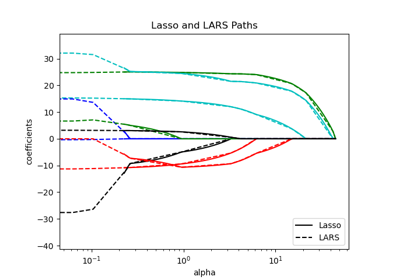
lars_path#
- sklearn.linear_model.lars_path(X, y, Xy=None, *, Gram=None, max_iter=500, alpha_min=0, method='lar', copy_X=True, eps=np.float64(2.220446049250313e-16), copy_Gram=True, verbose=0, return_path=True, return_n_iter=False, positive=False)[source]#
使用 LARS 算法计算最小角回归或 Lasso 路径。
当 method=’lasso’ 时,优化目标为
(1 / (2 * n_samples)) * ||y - Xw||^2_2 + alpha * ||w||_1
当 method=’lar’ 时,目标函数仅以隐式方程的形式已知(参见 [1] 中的讨论)。
Read more in the User Guide.
- 参数:
- XNone or ndarray of shape (n_samples, n_features)
输入数据。如果 X 是
None,则 Gram 也必须是None。如果只有 Gram 矩阵可用,请改用lars_path_gram。- yNone or ndarray of shape (n_samples,)
输入目标值。
- Xyarray-like of shape (n_features,), default=None
Xy = X.T @ y可以预先计算。仅当 Gram 矩阵预先计算时才有用。- GramNone, ‘auto’, bool, ndarray of shape (n_features, n_features), default=None
预先计算的 Gram 矩阵
X.T @ X。如果设置为'auto',则当样本数多于特征数时,会从给定的 X 预先计算 Gram 矩阵。- max_iterint, default=500
要执行的最大迭代次数,设置为无穷大表示没有限制。
- alpha_minfloat, default=0
路径上的最小相关性。它对应于 Lasso 中的正则化参数
alpha。- method{‘lar’, ‘lasso’}, default=’lar’
指定返回的模型。选择
'lar'代表最小角回归(Least Angle Regression),'lasso'代表 Lasso。- copy_Xbool, default=True
如果为
False,则会覆盖X。- epsfloat, default=np.finfo(float).eps
The machine-precision regularization in the computation of the Cholesky diagonal factors. Increase this for very ill-conditioned systems. Unlike the
tolparameter in some iterative optimization-based algorithms, this parameter does not control the tolerance of the optimization.- copy_Grambool, default=True
如果为
False,则会覆盖Gram。- verboseint, default=0
控制输出详细程度。
- return_pathbool, default=True
如果为
True,返回整个路径;否则只返回路径的最后一点。- return_n_iterbool, default=False
是否返回迭代次数。
- positivebool, default=False
限制系数 >= 0。此选项仅在 method ‘lasso’ 时允许使用。请注意,对于较小的 alpha 值,模型系数不会收敛到普通最小二乘解。只有达到分步 Lars-Lasso 算法所达到的最小 alpha 值(当 fit_path=True 时为
alphas_[alphas_ > 0.].min())的系数才通常与坐标下降lasso_path函数的解一致。
- 返回:
- alphasndarray of shape (n_alphas + 1,)
每次迭代中协方差的最大值(绝对值)。
n_alphas是max_iter、n_features,或者路径中alpha >= alpha_min的节点数,取其中较小者。- activendarray of shape (n_alphas,)
路径结束时活动变量的索引。
- coefsndarray of shape (n_features, n_alphas + 1)
路径上的系数。
- n_iter整型
运行的迭代次数。仅当
return_n_iter设置为 True 时返回。
另请参阅
lars_path_gram在充分统计模式下计算 LARS 路径。
lasso_path使用坐标下降计算 Lasso 路径。
LassoLars使用最小角回归(又名 Lars)拟合的 Lasso 模型。
Lars最小角回归模型,又名 LAR。
LassoLarsCV使用 LARS 算法的交叉验证 Lasso。
LarsCV交叉验证的最小角回归模型。
sklearn.decomposition.sparse_encode稀疏编码。
References
示例
>>> from sklearn.linear_model import lars_path
>>> from sklearn.datasets import make_regression
>>> X, y, true_coef = make_regression(
...    n_samples=100, n_features=5, n_informative=2, coef=True, random_state=0
... )
>>> true_coef
array([ 0.        ,  0.        ,  0.        , 97.9, 45.7])
>>> alphas, _, estimated_coef = lars_path(X, y)
>>> alphas.shape
(3,)
>>> estimated_coef
array([[ 0.     ,  0.     ,  0.     ],
       [ 0.     ,  0.     ,  0.     ],
       [ 0.     ,  0.     ,  0.     ],
       [ 0.     , 46.96, 97.99],
       [ 0.     ,  0.     , 45.70]])