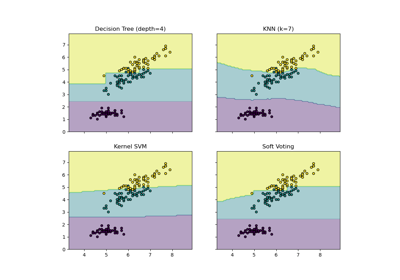
VotingClassifier#
- class sklearn.ensemble.VotingClassifier(estimators, *, voting='hard', weights=None, n_jobs=None, flatten_transform=True, verbose=False)[source]#
未拟合估算器的软投票/多数规则分类器。
Read more in the User Guide.
版本0.17中新增。
- 参数:
- estimatorslist of (str, estimator) tuples
Invoking the
fitmethod on theVotingClassifierwill fit clones of those original estimators that will be stored in the class attributeself.estimators_. An estimator can be set to'drop'usingset_params.Changed in version 0.21:
'drop'is accepted. Using None was deprecated in 0.22 and support was removed in 0.24.- voting{‘hard’, ‘soft’}, default=’hard’
If ‘hard’, uses predicted class labels for majority rule voting. Else if ‘soft’, predicts the class label based on the argmax of the sums of the predicted probabilities, which is recommended for an ensemble of well-calibrated classifiers.
- weightsarray-like of shape (n_classifiers,), default=None
Sequence of weights (
floatorint) to weight the occurrences of predicted class labels (hardvoting) or class probabilities before averaging (softvoting). Uses uniform weights ifNone.- n_jobsint, default=None
The number of jobs to run in parallel for
fit.Nonemeans 1 unless in ajoblib.parallel_backendcontext.-1means using all processors. See Glossary for more details.版本 0.18 新增。
- flatten_transformbool, default=True
Affects shape of transform output only when voting=’soft’ If voting=’soft’ and flatten_transform=True, transform method returns matrix with shape (n_samples, n_classifiers * n_classes). If flatten_transform=False, it returns (n_classifiers, n_samples, n_classes).
- verbosebool, default=False
If True, the time elapsed while fitting will be printed as it is completed.
0.23 版本新增。
- 属性:
- estimators_list of classifiers
The collection of fitted sub-estimators as defined in
estimatorsthat are not ‘drop’.- named_estimators_
Bunch 按名称访问任何已拟合的子估计器的属性。
0.20 版本新增。
- le_
LabelEncoder Transformer used to encode the labels during fit and decode during prediction.
- classes_ndarray of shape (n_classes,)
类别标签。
n_features_in_int在 拟合 期间看到的特征数。
- feature_names_in_shape 为 (
n_features_in_,) 的 ndarray 在 fit 期间看到的特征名称。仅当底层估计器在拟合时公开此类属性时才定义。
1.0 版本新增。
另请参阅
VotingRegressorPrediction voting regressor.
示例
>>> import numpy as np
>>> from sklearn.linear_model import LogisticRegression
>>> from sklearn.naive_bayes import GaussianNB
>>> from sklearn.ensemble import RandomForestClassifier, VotingClassifier
>>> clf1 = LogisticRegression(random_state=1)
>>> clf2 = RandomForestClassifier(n_estimators=50, random_state=1)
>>> clf3 = GaussianNB()
>>> X = np.array([[-1, -1], [-2, -1], [-3, -2], [1, 1], [2, 1], [3, 2]])
>>> y = np.array([1, 1, 1, 2, 2, 2])
>>> eclf1 = VotingClassifier(estimators=[
...         ('lr', clf1), ('rf', clf2), ('gnb', clf3)], voting='hard')
>>> eclf1 = eclf1.fit(X, y)
>>> print(eclf1.predict(X))
[1 1 1 2 2 2]
>>> np.array_equal(eclf1.named_estimators_.lr.predict(X),
...                eclf1.named_estimators_['lr'].predict(X))
True
>>> eclf2 = VotingClassifier(estimators=[
...         ('lr', clf1), ('rf', clf2), ('gnb', clf3)],
...         voting='soft')
>>> eclf2 = eclf2.fit(X, y)
>>> print(eclf2.predict(X))
[1 1 1 2 2 2]
To drop an estimator,
set_paramscan be used to remove it. Here we dropped one of the estimators, resulting in 2 fitted estimators>>> eclf2 = eclf2.set_params(lr='drop') >>> eclf2 = eclf2.fit(X, y) >>> len(eclf2.estimators_) 2
Setting
flatten_transform=Truewithvoting='soft'flattens output shape oftransform>>> eclf3 = VotingClassifier(estimators=[ ... ('lr', clf1), ('rf', clf2), ('gnb', clf3)], ... voting='soft', weights=[2,1,1], ... flatten_transform=True) >>> eclf3 = eclf3.fit(X, y) >>> print(eclf3.predict(X)) [1 1 1 2 2 2] >>> print(eclf3.transform(X).shape) (6, 6)
- fit(X, y, **fit_params)[source]#
拟合估计器。
- 参数:
- Xshape 为 (n_samples, n_features) 的 {array-like, sparse matrix}
训练向量,其中
n_samples是样本数量,n_features是特征数量。- yarray-like of shape (n_samples,)
目标值。
- **fit_paramsdict
Parameters to pass to the underlying estimators.
Added in version 1.5: Only available if
enable_metadata_routing=True, which can be set by usingsklearn.set_config(enable_metadata_routing=True). See Metadata Routing User Guide for more details.
- 返回:
- selfobject
返回实例本身。
- fit_transform(X, y=None, **fit_params)[source]#
Return class labels or probabilities for each estimator.
Return predictions for X for each estimator.
- 参数:
- X{array-like, sparse matrix, dataframe} of shape (n_samples, n_features)
输入样本。
- yndarray of shape (n_samples,), default=None
目标值(对于无监督转换,为 None)。
- **fit_paramsdict
Additional fit parameters.
- 返回:
- X_newndarray array of shape (n_samples, n_features_new)
转换后的数组。
- get_feature_names_out(input_features=None)[source]#
获取转换的输出特征名称。
- 参数:
- input_featuresarray-like of str or None, default=None
Not used, present here for API consistency by convention.
- 返回:
- feature_names_outstr 对象的 ndarray
转换后的特征名称。
- get_metadata_routing()[source]#
获取此对象的元数据路由。
请查阅 用户指南,了解路由机制如何工作。
1.5 版本新增。
- 返回:
- routingMetadataRouter
封装路由信息的
MetadataRouter。
- get_params(deep=True)[source]#
获取集合中估计器的参数。
返回构造函数中给定的参数以及
estimators参数中包含的估计器。- 参数:
- deepbool, default=True
将其设置为 True 将获取各种估计器以及估计器的参数。
- 返回:
- paramsdict
参数和估计器名称映射到它们的值,或者参数名称映射到它们的值。
- predict(X)[source]#
Predict class labels for X.
- 参数:
- Xshape 为 (n_samples, n_features) 的 {array-like, sparse matrix}
输入样本。
- 返回:
- majarray-like of shape (n_samples,)
Predicted class labels.
- predict_proba(X)[source]#
Compute probabilities of possible outcomes for samples in X.
- 参数:
- Xshape 为 (n_samples, n_features) 的 {array-like, sparse matrix}
输入样本。
- 返回:
- avgarray-like of shape (n_samples, n_classes)
Weighted average probability for each class per sample.
- score(X, y, sample_weight=None)[source]#
返回在提供的数据和标签上的 准确率 (accuracy)。
在多标签分类中,这是子集准确率 (subset accuracy),这是一个严格的指标,因为它要求每个样本的每个标签集都被正确预测。
- 参数:
- Xshape 为 (n_samples, n_features) 的 array-like
测试样本。
- yshape 为 (n_samples,) 或 (n_samples, n_outputs) 的 array-like
X的真实标签。- sample_weightshape 为 (n_samples,) 的 array-like, default=None
样本权重。
- 返回:
- scorefloat
self.predict(X)相对于y的平均准确率。
- set_output(*, transform=None)[source]#
设置输出容器。
有关如何使用 API 的示例,请参阅引入 set_output API。
- 参数:
- transform{“default”, “pandas”, “polars”}, default=None
配置
transform和fit_transform的输出。"default": 转换器的默认输出格式"pandas": DataFrame 输出"polars": Polars 输出None: 转换配置保持不变
1.4 版本新增: 添加了
"polars"选项。
- 返回:
- selfestimator instance
估计器实例。
- set_params(**params)[source]#
设置集合中估计器的参数。
有效的参数键可以通过
get_params()列出。请注意,您可以直接设置estimators中包含的估计器的参数。- 参数:
- **paramskeyword arguments
使用例如
set_params(parameter_name=new_value)设置特定参数。除了设置估计器的参数外,还可以设置estimators的单个估计器,或者通过将它们设置为 ‘drop’ 来移除。
- 返回:
- selfobject
估计器实例。
- set_score_request(*, sample_weight: bool | None | str = '$UNCHANGED$') VotingClassifier[source]#
配置是否应请求元数据以传递给
score方法。请注意,此方法仅在以下情况下相关:此估计器用作 元估计器 中的子估计器,并且通过
enable_metadata_routing=True启用了元数据路由(请参阅sklearn.set_config)。请查看 用户指南 以了解路由机制的工作原理。每个参数的选项如下:
True:请求元数据,如果提供则传递给score。如果未提供元数据,则忽略该请求。False:不请求元数据,元估计器不会将其传递给score。None:不请求元数据,如果用户提供元数据,元估计器将引发错误。str:应将元数据以给定别名而不是原始名称传递给元估计器。
默认值 (
sklearn.utils.metadata_routing.UNCHANGED) 保留现有请求。这允许您更改某些参数的请求而不更改其他参数。在版本 1.3 中新增。
- 参数:
- sample_weightstr, True, False, or None, default=sklearn.utils.metadata_routing.UNCHANGED
score方法中sample_weight参数的元数据路由。
- 返回:
- selfobject
更新后的对象。
- transform(X)[source]#
Return class labels or probabilities for X for each estimator.
- 参数:
- Xshape 为 (n_samples, n_features) 的 {array-like, sparse matrix}
训练向量,其中
n_samples是样本数量,n_features是特征数量。
- 返回:
- probabilities_or_labels
- If
voting='soft'andflatten_transform=True returns ndarray of shape (n_samples, n_classifiers * n_classes), being class probabilities calculated by each classifier.
- If
voting='soft' and `flatten_transform=False ndarray of shape (n_classifiers, n_samples, n_classes)
- If
voting='hard' ndarray of shape (n_samples, n_classifiers), being class labels predicted by each classifier.
- If