SpectralEmbedding#
- class sklearn.manifold.SpectralEmbedding(n_components=2, *, affinity='nearest_neighbors', gamma=None, random_state=None, eigen_solver=None, eigen_tol='auto', n_neighbors=None, n_jobs=None)[source]#
用于非线性降维的谱嵌入。
根据指定的函数形成一个亲和矩阵,并对相应的图拉普拉斯算子应用谱分解。得到的变换由每个数据点的特征向量值给出。
注:拉普拉斯特征图(Laplacian Eigenmaps)是此处实现的实际算法。
在用户指南中阅读更多内容。
- 参数:
- n_componentsint, default=2
投影子空间的维度。
- affinity{‘nearest_neighbors’, ‘rbf’, ‘precomputed’, ‘precomputed_nearest_neighbors’} 或 callable, default=’nearest_neighbors’
- 如何构建亲和矩阵。
‘nearest_neighbors’:通过计算最近邻图来构建亲和矩阵。
‘rbf’:通过计算径向基函数(RBF)核来构建亲和矩阵。
‘precomputed’:将
X解释为预计算的亲和矩阵。‘precomputed_nearest_neighbors’:将
X解释为预计算最近邻的稀疏图,并通过选择n_neighbors个最近邻来构建亲和矩阵。callable:使用传入的函数作为亲和函数,该函数接受数据矩阵(n_samples, n_features)并返回亲和矩阵(n_samples, n_samples)。
- gammafloat, default=None
RBF核的核系数。如果为None,gamma将被设置为1/n_features。
- random_stateint, RandomState instance or None, default=None
当
eigen_solver == 'amg'时,用于初始化lobpcg特征向量分解的伪随机数生成器,以及用于K-Means初始化。使用整数可以使结果在不同调用中具有确定性(参见词汇表)。注意
用于初始化 lobpcg 特征向量分解的伪随机数生成器,当
eigen_solver == 'amg'时,以及用于 K-Means 初始化。使用整数使结果在多次调用中具有确定性(请参阅 词汇表)。- 要形成的聚类数。
要使用的特征值分解策略。AMG需要安装pyamg。它在非常大、稀疏的问题上可能更快。如果为None,则使用
'arpack'。- 使用最近邻方法构造亲和力矩阵时要使用的邻居数。对于
affinity='rbf',将被忽略。 Stopping criterion for eigendecomposition of the Laplacian matrix. If
eigen_tol="auto"then the passed tolerance will depend on theeigen_solver拉普拉斯矩阵特征分解的停止准则。如果
eigen_tol="auto",则传递的容差将取决于eigen_solver如果
eigen_solver="arpack",则eigen_tol=0.0;
如果
eigen_solver="lobpcg"或eigen_solver="amg",则eigen_tol=None,它将配置底层lobpcg求解器根据其启发式方法自动解析值。有关详细信息,请参阅scipy.sparse.linalg.lobpcg。1.2 版本新增。
- n_neighborsint, default=None
用于nearest_neighbors图构建的最近邻居数量。如果为None,n_neighbors将被设置为max(n_samples/10, 1)。
- n_jobsint, default=None
The number of parallel jobs to run.
Nonemeans 1 unless in ajoblib.parallel_backendcontext.-1means using all processors. See Glossary for more details.
- 属性:
- embedding_形状为 (n_samples, n_components) 的 ndarray
训练矩阵的谱嵌入。
- affinity_matrix_shape (n_samples, n_samples) 的 ndarray
从样本构建或预计算的亲和矩阵。
- n_features_in_int
在 拟合 期间看到的特征数。
0.24 版本新增。
- feature_names_in_shape 为 (
n_features_in_,) 的 ndarray 在 fit 期间看到的特征名称。仅当
X具有全部为字符串的特征名称时才定义。1.0 版本新增。
- n_neighbors_int
实际使用的最近邻居数量。
另请参阅
Isomap通过等距映射进行的非线性降维。
References
示例
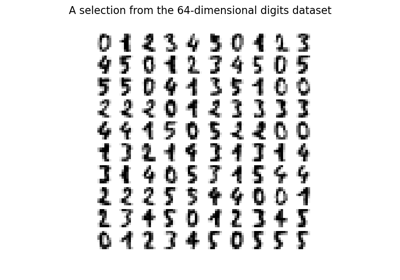
>>> from sklearn.datasets import load_digits
>>> from sklearn.manifold import SpectralEmbedding
>>> X, _ = load_digits(return_X_y=True)
>>> X.shape
(1797, 64)
>>> embedding = SpectralEmbedding(n_components=2)
>>> X_transformed = embedding.fit_transform(X[:100])
>>> X_transformed.shape
(100, 2)
- fit(X, y=None)[source]#
根据 X 中的数据拟合模型。
- 参数:
- Xshape 为 (n_samples, n_features) 的 {array-like, sparse matrix}
训练向量,其中
n_samples是样本数,n_features是特征数。如果affinity是“precomputed”,则X:{类数组, 稀疏矩阵},shape (n_samples, n_samples),将X解释为从样本计算的预计算邻接图。
- y被忽略
未使用,按照惯例为保持 API 一致性而存在。
- 返回:
- selfobject
返回实例本身。
- fit_transform(X, y=None)[source]#
从 X 中的数据拟合模型并转换 X。
- 参数:
- Xshape 为 (n_samples, n_features) 的 {array-like, sparse matrix}
训练向量,其中
n_samples是样本数,n_features是特征数。如果affinity是“precomputed”,则X:shape (n_samples, n_samples) 的 {类数组, 稀疏矩阵},将X解释为从样本计算的预计算邻接图。
- y被忽略
未使用,按照惯例为保持 API 一致性而存在。
- 返回:
- X_newshape (n_samples, n_components) 的类数组
训练矩阵的谱嵌入。
- get_metadata_routing()[source]#
获取此对象的元数据路由。
请查阅 用户指南,了解路由机制如何工作。
- 返回:
- routingMetadataRequest
封装路由信息的
MetadataRequest。