KMeans#
- class sklearn.cluster.KMeans(n_clusters=8, *, init='k-means++', n_init='auto', max_iter=300, tol=0.0001, verbose=0, random_state=None, copy_x=True, algorithm='lloyd')[source]#
K-Means 聚类。
Read more in the User Guide.
- 参数:
- n_clustersint, default=8
The number of clusters to form as well as the number of centroids to generate.
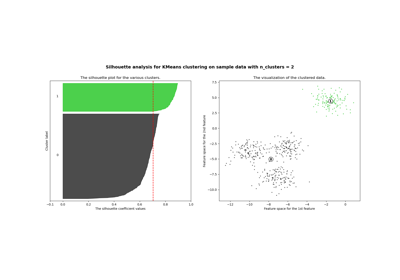
For an example of how to choose an optimal value for
n_clustersrefer to Selecting the number of clusters with silhouette analysis on KMeans clustering.- init{‘k-means++’, ‘random’}, callable or array-like of shape (n_clusters, n_features), default=’k-means++’
Method for initialization
‘k-means++’ : selects initial cluster centroids using sampling based on an empirical probability distribution of the points’ contribution to the overall inertia. This technique speeds up convergence. The algorithm implemented is “greedy k-means++”. It differs from the vanilla k-means++ by making several trials at each sampling step and choosing the best centroid among them.
‘random’: choose
n_clustersobservations (rows) at random from data for the initial centroids.If an array is passed, it should be of shape (n_clusters, n_features) and gives the initial centers.
If a callable is passed, it should take arguments X, n_clusters and a random state and return an initialization.
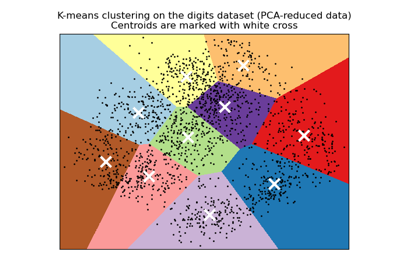
For an example of how to use the different
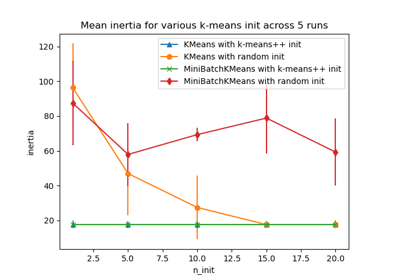
initstrategies, see A demo of K-Means clustering on the handwritten digits data.For an evaluation of the impact of initialization, see the example Empirical evaluation of the impact of k-means initialization.
- n_init‘auto’ or int, default=’auto’
Number of times the k-means algorithm is run with different centroid seeds. The final results is the best output of
n_initconsecutive runs in terms of inertia. Several runs are recommended for sparse high-dimensional problems (see Clustering sparse data with k-means).When
n_init='auto', the number of runs depends on the value of init: 10 if usinginit='random'orinitis a callable; 1 if usinginit='k-means++'orinitis an array-like.Added in version 1.2: Added ‘auto’ option for
n_init.Changed in version 1.4: Default value for
n_initchanged to'auto'.- max_iterint, default=300
Maximum number of iterations of the k-means algorithm for a single run.
- tolfloat, default=1e-4
Relative tolerance with regards to Frobenius norm of the difference in the cluster centers of two consecutive iterations to declare convergence.
- verboseint, default=0
Verbosity mode.
- random_stateint, RandomState instance or None, default=None
Determines random number generation for centroid initialization. Use an int to make the randomness deterministic. See Glossary.
- copy_xbool, default=True
When pre-computing distances it is more numerically accurate to center the data first. If copy_x is True (default), then the original data is not modified. If False, the original data is modified, and put back before the function returns, but small numerical differences may be introduced by subtracting and then adding the data mean. Note that if the original data is not C-contiguous, a copy will be made even if copy_x is False. If the original data is sparse, but not in CSR format, a copy will be made even if copy_x is False.
- algorithm{“lloyd”, “elkan”}, default=”lloyd”
K-means algorithm to use. The classical EM-style algorithm is
"lloyd". The"elkan"variation can be more efficient on some datasets with well-defined clusters, by using the triangle inequality. However it’s more memory intensive due to the allocation of an extra array of shape(n_samples, n_clusters).Changed in version 0.18: Added Elkan algorithm
Changed in version 1.1: Renamed “full” to “lloyd”, and deprecated “auto” and “full”. Changed “auto” to use “lloyd” instead of “elkan”.
- 属性:
- cluster_centers_ndarray of shape (n_clusters, n_features)
Coordinates of cluster centers. If the algorithm stops before fully converging (see
tolandmax_iter), these will not be consistent withlabels_.- labels_ndarray of shape (n_samples,)
Labels of each point
- inertia_float
Sum of squared distances of samples to their closest cluster center, weighted by the sample weights if provided.
- n_iter_int
运行的迭代次数。
- n_features_in_int
在 拟合 期间看到的特征数。
0.24 版本新增。
- feature_names_in_shape 为 (
n_features_in_,) 的 ndarray 在 fit 期间看到的特征名称。仅当
X具有全部为字符串的特征名称时才定义。1.0 版本新增。
另请参阅
MiniBatchKMeansAlternative online implementation that does incremental updates of the centers positions using mini-batches. For large scale learning (say n_samples > 10k) MiniBatchKMeans is probably much faster than the default batch implementation.
注意事项
The k-means problem is solved using either Lloyd’s or Elkan’s algorithm.
The average complexity is given by O(k n T), where n is the number of samples and T is the number of iteration.
The worst case complexity is given by O(n^(k+2/p)) with n = n_samples, p = n_features. Refer to “How slow is the k-means method?” D. Arthur and S. Vassilvitskii - SoCG2006. for more details.
In practice, the k-means algorithm is very fast (one of the fastest clustering algorithms available), but it falls in local minima. That’s why it can be useful to restart it several times.
If the algorithm stops before fully converging (because of
tolormax_iter),labels_andcluster_centers_will not be consistent, i.e. thecluster_centers_will not be the means of the points in each cluster. Also, the estimator will reassignlabels_after the last iteration to makelabels_consistent withpredicton the training set.示例
>>> from sklearn.cluster import KMeans
>>> import numpy as np
>>> X = np.array([[1, 2], [1, 4], [1, 0],
...               [10, 2], [10, 4], [10, 0]])
>>> kmeans = KMeans(n_clusters=2, random_state=0, n_init="auto").fit(X)
>>> kmeans.labels_
array([1, 1, 1, 0, 0, 0], dtype=int32)
>>> kmeans.predict([[0, 0], [12, 3]])
array([1, 0], dtype=int32)
>>> kmeans.cluster_centers_
array([[10.,  2.],
       [ 1.,  2.]])
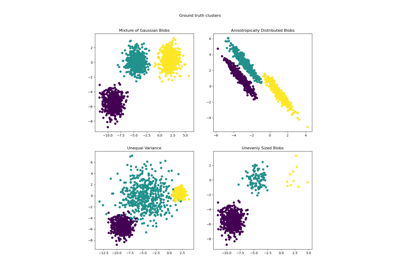
For examples of common problems with K-Means and how to address them see Demonstration of k-means assumptions.
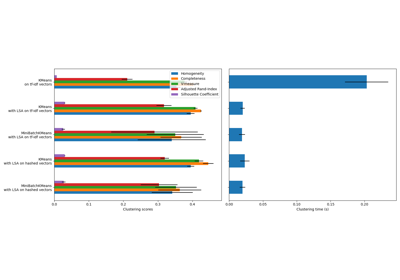
For a demonstration of how K-Means can be used to cluster text documents see Clustering text documents using k-means.
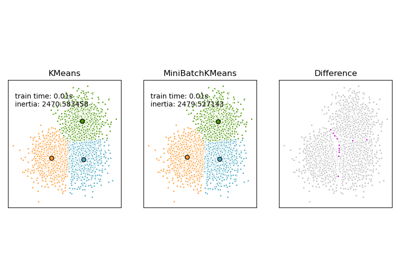
For a comparison between K-Means and MiniBatchKMeans refer to example Comparison of the K-Means and MiniBatchKMeans clustering algorithms.
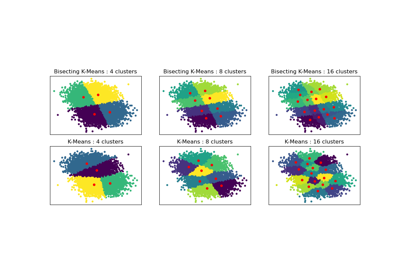
For a comparison between K-Means and BisectingKMeans refer to example Bisecting K-Means and Regular K-Means Performance Comparison.
- fit(X, y=None, sample_weight=None)[source]#
Compute k-means clustering.
- 参数:
- Xshape 为 (n_samples, n_features) 的 {array-like, sparse matrix}
Training instances to cluster. It must be noted that the data will be converted to C ordering, which will cause a memory copy if the given data is not C-contiguous. If a sparse matrix is passed, a copy will be made if it’s not in CSR format.
- y被忽略
Not used, present here for API consistency by convention.
- sample_weightshape 为 (n_samples,) 的 array-like, default=None
The weights for each observation in X. If None, all observations are assigned equal weight.
sample_weightis not used during initialization ifinitis a callable or a user provided array.0.20 版本新增。
- 返回:
- selfobject
拟合的估计器。
- fit_predict(X, y=None, sample_weight=None)[source]#
Compute cluster centers and predict cluster index for each sample.
Convenience method; equivalent to calling fit(X) followed by predict(X).
- 参数:
- Xshape 为 (n_samples, n_features) 的 {array-like, sparse matrix}
New data to transform.
- y被忽略
Not used, present here for API consistency by convention.
- sample_weightshape 为 (n_samples,) 的 array-like, default=None
The weights for each observation in X. If None, all observations are assigned equal weight.
- 返回:
- labelsndarray of shape (n_samples,)
Index of the cluster each sample belongs to.
- fit_transform(X, y=None, sample_weight=None)[source]#
Compute clustering and transform X to cluster-distance space.
Equivalent to fit(X).transform(X), but more efficiently implemented.
- 参数:
- Xshape 为 (n_samples, n_features) 的 {array-like, sparse matrix}
New data to transform.
- y被忽略
Not used, present here for API consistency by convention.
- sample_weightshape 为 (n_samples,) 的 array-like, default=None
The weights for each observation in X. If None, all observations are assigned equal weight.
- 返回:
- X_newndarray of shape (n_samples, n_clusters)
X transformed in the new space.
- get_feature_names_out(input_features=None)[source]#
获取转换的输出特征名称。
The feature names out will prefixed by the lowercased class name. For example, if the transformer outputs 3 features, then the feature names out are:
["class_name0", "class_name1", "class_name2"].- 参数:
- input_featuresarray-like of str or None, default=None
Only used to validate feature names with the names seen in
fit.
- 返回:
- feature_names_outstr 对象的 ndarray
转换后的特征名称。
- get_metadata_routing()[source]#
获取此对象的元数据路由。
请查阅 用户指南,了解路由机制如何工作。
- 返回:
- routingMetadataRequest
封装路由信息的
MetadataRequest。
- get_params(deep=True)[source]#
获取此估计器的参数。
- 参数:
- deepbool, default=True
如果为 True,将返回此估计器以及包含的子对象(如果它们是估计器)的参数。
- 返回:
- paramsdict
参数名称映射到其值。
- predict(X)[source]#
Predict the closest cluster each sample in X belongs to.
In the vector quantization literature,
cluster_centers_is called the code book and each value returned bypredictis the index of the closest code in the code book.- 参数:
- Xshape 为 (n_samples, n_features) 的 {array-like, sparse matrix}
New data to predict.
- 返回:
- labelsndarray of shape (n_samples,)
Index of the cluster each sample belongs to.
- score(X, y=None, sample_weight=None)[source]#
Opposite of the value of X on the K-means objective.
- 参数:
- Xshape 为 (n_samples, n_features) 的 {array-like, sparse matrix}
New data.
- y被忽略
Not used, present here for API consistency by convention.
- sample_weightshape 为 (n_samples,) 的 array-like, default=None
The weights for each observation in X. If None, all observations are assigned equal weight.
- 返回:
- scorefloat
Opposite of the value of X on the K-means objective.
- set_fit_request(*, sample_weight: bool | None | str = '$UNCHANGED$') KMeans[source]#
配置是否应请求元数据以传递给
fit方法。请注意,此方法仅在以下情况下相关:此估计器用作 元估计器 中的子估计器,并且通过
enable_metadata_routing=True启用了元数据路由(请参阅sklearn.set_config)。请查看 用户指南 以了解路由机制的工作原理。每个参数的选项如下:
True:请求元数据,如果提供则传递给fit。如果未提供元数据,则忽略该请求。False:不请求元数据,元估计器不会将其传递给fit。None:不请求元数据,如果用户提供元数据,元估计器将引发错误。str:应将元数据以给定别名而不是原始名称传递给元估计器。
默认值 (
sklearn.utils.metadata_routing.UNCHANGED) 保留现有请求。这允许您更改某些参数的请求而不更改其他参数。在版本 1.3 中新增。
- 参数:
- sample_weightstr, True, False, or None, default=sklearn.utils.metadata_routing.UNCHANGED
fit方法中sample_weight参数的元数据路由。
- 返回:
- selfobject
更新后的对象。
- set_output(*, transform=None)[source]#
设置输出容器。
有关如何使用 API 的示例,请参阅引入 set_output API。
- 参数:
- transform{“default”, “pandas”, “polars”}, default=None
配置
transform和fit_transform的输出。"default": 转换器的默认输出格式"pandas": DataFrame 输出"polars": Polars 输出None: 转换配置保持不变
1.4 版本新增: 添加了
"polars"选项。
- 返回:
- selfestimator instance
估计器实例。
- set_params(**params)[source]#
设置此估计器的参数。
此方法适用于简单的估计器以及嵌套对象(如
Pipeline)。后者具有<component>__<parameter>形式的参数,以便可以更新嵌套对象的每个组件。- 参数:
- **paramsdict
估计器参数。
- 返回:
- selfestimator instance
估计器实例。
- set_score_request(*, sample_weight: bool | None | str = '$UNCHANGED$') KMeans[source]#
配置是否应请求元数据以传递给
score方法。请注意,此方法仅在以下情况下相关:此估计器用作 元估计器 中的子估计器,并且通过
enable_metadata_routing=True启用了元数据路由(请参阅sklearn.set_config)。请查看 用户指南 以了解路由机制的工作原理。每个参数的选项如下:
True:请求元数据,如果提供则传递给score。如果未提供元数据,则忽略该请求。False:不请求元数据,元估计器不会将其传递给score。None:不请求元数据,如果用户提供元数据,元估计器将引发错误。str:应将元数据以给定别名而不是原始名称传递给元估计器。
默认值 (
sklearn.utils.metadata_routing.UNCHANGED) 保留现有请求。这允许您更改某些参数的请求而不更改其他参数。在版本 1.3 中新增。
- 参数:
- sample_weightstr, True, False, or None, default=sklearn.utils.metadata_routing.UNCHANGED
score方法中sample_weight参数的元数据路由。
- 返回:
- selfobject
更新后的对象。
- transform(X)[source]#
Transform X to a cluster-distance space.
In the new space, each dimension is the distance to the cluster centers. Note that even if X is sparse, the array returned by
transformwill typically be dense.- 参数:
- Xshape 为 (n_samples, n_features) 的 {array-like, sparse matrix}
New data to transform.
- 返回:
- X_newndarray of shape (n_samples, n_clusters)
X transformed in the new space.