KNeighborsClassifier#
- class sklearn.neighbors.KNeighborsClassifier(n_neighbors=5, *, weights='uniform', algorithm='auto', leaf_size=30, p=2, metric='minkowski', metric_params=None, n_jobs=None)[source]#
实现 k 最近邻投票的分类器。
Read more in the User Guide.
- 参数:
- n_neighborsint, default=5
Number of neighbors to use by default for
kneighborsqueries.- weights{‘uniform’, ‘distance’}, callable 或 None, 默认值=’uniform’
预测中使用的权重函数。可能的值:
‘uniform’:均匀权重。邻域中的所有点都具有相同的权重。
‘distance’:按距离的倒数对点进行加权。在这种情况下,查询点越近的邻居将比越远的邻居具有更大的影响力。
[callable] : 一个用户定义的函数,它接受一个距离数组,并返回一个具有相同形状的数组,其中包含权重。
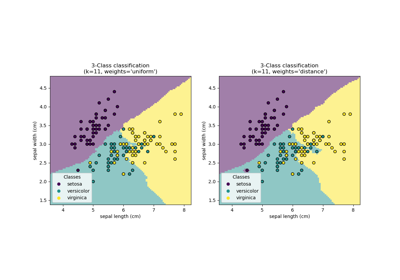
Refer to the example entitled Nearest Neighbors Classification showing the impact of the
weightsparameter on the decision boundary.- algorithm{‘auto’, ‘ball_tree’, ‘kd_tree’, ‘brute’}, default=’auto’
用于计算最近邻居的算法
‘ball_tree’ 将使用
BallTree‘kd_tree’ 将使用
KDTree'brute' 将使用暴力搜索。
‘auto’ will attempt to decide the most appropriate algorithm based on the values passed to
fitmethod.
注意:对稀疏输入进行拟合将覆盖此参数的设置,使用暴力方法。
- leaf_sizeint, default=30
传递给 BallTree 或 KDTree 的叶子大小。这会影响构建和查询的速度,以及存储树所需的内存。最佳值取决于问题的性质。
- pfloat, default=2
Minkowski 度量的幂参数。当 p = 1 时,这相当于使用 manhattan_distance (l1),而 p = 2 时使用 euclidean_distance (l2)。对于任意 p,使用 minkowski_distance (l_p)。此参数预期为正数。
- metricstr or callable, default=’minkowski’
用于距离计算的度量。默认为“minkowski”,当 p = 2 时,它会产生标准的欧几里得距离。有关有效的度量值,请参阅scipy.spatial.distance的文档以及
distance_metrics中列出的度量。如果 metric 为 “precomputed”,则 X 被假定为一个距离矩阵,并且在 fit 时必须是方形的。X 可以是 稀疏图,在这种情况下,只有“非零”元素可能被视为邻居。
如果 metric 是可调用函数,它接受表示 1D 向量的两个数组作为输入,并且必须返回一个值来指示这些向量之间的距离。这适用于 Scipy 的度量,但效率低于将度量名称作为字符串传递。
- metric_paramsdict, default=None
度量函数的附加关键字参数。
- n_jobsint, default=None
The number of parallel jobs to run for neighbors search.
Nonemeans 1 unless in ajoblib.parallel_backendcontext.-1means using all processors. See Glossary for more details. Doesn’t affectfitmethod.
- 属性:
- classes_array of shape (n_classes,)
分类器已知的类别标签
- effective_metric_str or callble
使用的距离度量。它将与
metric参数相同或其同义词,例如,如果metric参数设置为 'minkowski' 且p参数设置为 2,则为 'euclidean'。- effective_metric_params_dict
度量函数的附加关键字参数。对于大多数度量,将与
metric_params参数相同,但如果effective_metric_属性设置为 'minkowski',也可能包含p参数值。- n_features_in_int
在 拟合 期间看到的特征数。
0.24 版本新增。
- feature_names_in_shape 为 (
n_features_in_,) 的 ndarray 在 fit 期间看到的特征名称。仅当
X具有全部为字符串的特征名称时才定义。1.0 版本新增。
- n_samples_fit_int
拟合数据中的样本数量。
- outputs_2d_bool
False when
y’s shape is (n_samples, ) or (n_samples, 1) during fit otherwise True.
另请参阅
RadiusNeighborsClassifierClassifier based on neighbors within a fixed radius.
KNeighborsRegressor基于 k 最近邻的回归。
RadiusNeighborsRegressor基于固定半径内邻居的回归。
NearestNeighbors用于实现邻居搜索的无监督学习器。
注意事项
有关 `algorithm` 和 `leaf_size` 选择的讨论,请参阅在线文档中的 最近邻。
警告
Regarding the Nearest Neighbors algorithms, if it is found that two neighbors, neighbor
k+1andk, have identical distances but different labels, the results will depend on the ordering of the training data.https://en.wikipedia.org/wiki/K-nearest_neighbor_algorithm
示例
>>> X = [[0], [1], [2], [3]]
>>> y = [0, 0, 1, 1]
>>> from sklearn.neighbors import KNeighborsClassifier
>>> neigh = KNeighborsClassifier(n_neighbors=3)
>>> neigh.fit(X, y)
KNeighborsClassifier(...)
>>> print(neigh.predict([[1.1]]))
[0]
>>> print(neigh.predict_proba([[0.9]]))
[[0.666 0.333]]
- fit(X, y)[source]#
Fit the k-nearest neighbors classifier from the training dataset.
- 参数:
- X{类数组, 稀疏矩阵},形状为 (n_samples, n_features) 或 (n_samples, n_samples) 如果 metric='precomputed'
训练数据。
- y{array-like, sparse matrix} of shape (n_samples,) or (n_samples, n_outputs)
目标值。
- 返回:
- selfKNeighborsClassifier
The fitted k-nearest neighbors classifier.
- get_metadata_routing()[source]#
获取此对象的元数据路由。
请查阅 用户指南,了解路由机制如何工作。
- 返回:
- routingMetadataRequest
封装路由信息的
MetadataRequest。
- get_params(deep=True)[source]#
获取此估计器的参数。
- 参数:
- deepbool, default=True
如果为 True,将返回此估计器以及包含的子对象(如果它们是估计器)的参数。
- 返回:
- paramsdict
参数名称映射到其值。
- kneighbors(X=None, n_neighbors=None, return_distance=True)[source]#
找到一个点的 K-邻居。
返回每个点的邻居的索引和距离。
- 参数:
- X{类数组, 稀疏矩阵},形状为 (n_queries, n_features),如果 metric == ‘precomputed’ 则为 (n_queries, n_indexed),默认=None
查询点或点集。如果未提供,则返回每个索引点的邻居。在这种情况下,查询点不被视为其自身的邻居。
- n_neighborsint, default=None
每个样本所需的邻居数量。默认值为构造函数中传递的值。
- return_distance布尔值,默认=True
是否返回距离。
- 返回:
- neigh_distndarray,形状为 (n_queries, n_neighbors)
表示到点的长度的数组,仅当 return_distance=True 时存在。
- neigh_indndarray,形状为 (n_queries, n_neighbors)
总体矩阵中最近点的索引。
示例
在以下示例中,我们从表示我们数据集的数组构建了一个 NearestNeighbors 类,并询问哪个点离 [1,1,1] 最近。
>>> samples = [[0., 0., 0.], [0., .5, 0.], [1., 1., .5]]
>>> from sklearn.neighbors import NearestNeighbors
>>> neigh = NearestNeighbors(n_neighbors=1)
>>> neigh.fit(samples)
NearestNeighbors(n_neighbors=1)
>>> print(neigh.kneighbors([[1., 1., 1.]]))
(array([[0.5]]), array([[2]]))
正如您所看到的,它返回 [[0.5]] 和 [[2]],这意味着该元素距离为 0.5,并且是样本中的第三个元素(索引从 0 开始)。您还可以查询多个点。
>>> X = [[0., 1., 0.], [1., 0., 1.]]
>>> neigh.kneighbors(X, return_distance=False)
array([[1],
       [2]]...)
- kneighbors_graph(X=None, n_neighbors=None, mode='connectivity')[source]#
计算 X 中点的 k-Neighbors(加权)图。
- 参数:
- X{类数组, 稀疏矩阵},形状为 (n_queries, n_features),如果 metric == ‘precomputed’ 则为 (n_queries, n_indexed),默认=None
查询点或点集。如果未提供,则返回每个索引点的邻居。在这种情况下,查询点不被视为其自身的邻居。对于
metric='precomputed',形状应为 (n_queries, n_indexed)。否则,形状应为 (n_queries, n_features)。- n_neighborsint, default=None
每个样本的邻居数量。默认值为构造函数中传递的值。
- mode{‘connectivity’, ‘distance’}, default=’connectivity’
返回矩阵的类型:‘connectivity’ 将返回包含 1 和 0 的连通性矩阵,‘distance’ 中边是点之间的距离,距离类型取决于 NearestNeighbors 类中选择的度量参数。
- 返回:
- A稀疏矩阵,形状为 (n_queries, n_samples_fit)
n_samples_fit是拟合数据中的样本数量。A[i, j]给出连接i到j的边的权重。矩阵为 CSR 格式。
另请参阅
NearestNeighbors.radius_neighbors_graph计算 X 中点的 Neighbors(加权)图。
示例
>>> X = [[0], [3], [1]]
>>> from sklearn.neighbors import NearestNeighbors
>>> neigh = NearestNeighbors(n_neighbors=2)
>>> neigh.fit(X)
NearestNeighbors(n_neighbors=2)
>>> A = neigh.kneighbors_graph(X)
>>> A.toarray()
array([[1., 0., 1.],
       [0., 1., 1.],
       [1., 0., 1.]])
- predict(X)[source]#
Predict the class labels for the provided data.
- 参数:
- X{array-like, sparse matrix} of shape (n_queries, n_features), or (n_queries, n_indexed) if metric == ‘precomputed’, or None
测试样本。如果为
None,则返回所有索引点的预测;在这种情况下,点不被视为其自身的邻居。
- 返回:
- yndarray of shape (n_queries,) or (n_queries, n_outputs)
Class labels for each data sample.
- predict_proba(X)[source]#
Return probability estimates for the test data X.
- 参数:
- X{array-like, sparse matrix} of shape (n_queries, n_features), or (n_queries, n_indexed) if metric == ‘precomputed’, or None
测试样本。如果为
None,则返回所有索引点的预测;在这种情况下,点不被视为其自身的邻居。
- 返回:
- pndarray of shape (n_queries, n_classes), or a list of n_outputs of such arrays if n_outputs > 1.
The class probabilities of the input samples. Classes are ordered by lexicographic order.
- score(X, y, sample_weight=None)[source]#
Return the mean accuracy on the given test data and labels.
在多标签分类中,这是子集准确率 (subset accuracy),这是一个严格的指标,因为它要求每个样本的每个标签集都被正确预测。
- 参数:
- Xarray-like of shape (n_samples, n_features), or None
Test samples. If
None, predictions for all indexed points are used; in this case, points are not considered their own neighbors. This means thatknn.fit(X, y).score(None, y)implicitly performs a leave-one-out cross-validation procedure and is equivalent tocross_val_score(knn, X, y, cv=LeaveOneOut())but typically much faster.- yshape 为 (n_samples,) 或 (n_samples, n_outputs) 的 array-like
X的真实标签。- sample_weightshape 为 (n_samples,) 的 array-like, default=None
样本权重。
- 返回:
- scorefloat
self.predict(X)相对于y的平均准确率。
- set_params(**params)[source]#
设置此估计器的参数。
此方法适用于简单的估计器以及嵌套对象(如
Pipeline)。后者具有<component>__<parameter>形式的参数,以便可以更新嵌套对象的每个组件。- 参数:
- **paramsdict
估计器参数。
- 返回:
- selfestimator instance
估计器实例。
- set_score_request(*, sample_weight: bool | None | str = '$UNCHANGED$') KNeighborsClassifier[source]#
配置是否应请求元数据以传递给
score方法。请注意,此方法仅在以下情况下相关:此估计器用作 元估计器 中的子估计器,并且通过
enable_metadata_routing=True启用了元数据路由(请参阅sklearn.set_config)。请查看 用户指南 以了解路由机制的工作原理。每个参数的选项如下:
True:请求元数据,如果提供则传递给score。如果未提供元数据,则忽略该请求。False:不请求元数据,元估计器不会将其传递给score。None:不请求元数据,如果用户提供元数据,元估计器将引发错误。str:应将元数据以给定别名而不是原始名称传递给元估计器。
默认值 (
sklearn.utils.metadata_routing.UNCHANGED) 保留现有请求。这允许您更改某些参数的请求而不更改其他参数。在版本 1.3 中新增。
- 参数:
- sample_weightstr, True, False, or None, default=sklearn.utils.metadata_routing.UNCHANGED
score方法中sample_weight参数的元数据路由。
- 返回:
- selfobject
更新后的对象。