注意
转到末尾下载完整示例代码或通过 JupyterLite 或 Binder 在浏览器中运行此示例。
线性模型系数解释中的常见误区#
在线性模型中,目标值被建模为特征的线性组合(请参阅 线性模型 用户指南部分,了解 scikit-learn 中可用的线性模型集)。多元线性模型中的系数表示给定特征 \(X_i\) 与目标 \(y\) 之间的关系,前提是所有其他特征保持不变(条件依赖)。这与绘制 \(X_i\) 与 \(y\) 的关系并拟合线性关系不同:在这种情况下,估计中会考虑其他特征的所有可能值(边际依赖)。
本示例将提供一些解释线性模型系数的提示,指出当线性模型不适合描述数据集或特征相关时出现的问题。
注意
请记住,特征 \(X\) 和结果 \(y\) 通常是我们未知的数据生成过程的结果。机器学习模型经过训练,可以从样本数据中近似连接 \(X\) 到 \(y\) 的未观察到的数学函数。因此,对模型所做的任何解释不一定能推广到真实的数据生成过程。当模型质量差或样本数据不具有代表性时,尤其如此。
我们将使用 1985 年 “当前人口调查” 的数据来预测工资与经验、年龄或教育等各种特征的函数关系。
# Authors: The scikit-learn developers
# SPDX-License-Identifier: BSD-3-Clause
import matplotlib.pyplot as plt
import numpy as np
import pandas as pd
import scipy as sp
import seaborn as sns
数据集:工资#
我们从 OpenML 获取数据。请注意,将参数 as_frame 设置为 True 将把数据作为 pandas 数据框检索。
from sklearn.datasets import fetch_openml

survey = fetch_openml(data_id=534, as_frame=True)
然后,我们确定特征 X 和目标 y:WAGE 列是我们的目标变量(即我们想要预测的变量)。
X = survey.data[survey.feature_names]
X.describe(include="all")
请注意,数据集包含分类变量和数值变量。我们稍后在预处理数据集时需要考虑到这一点。
X.head()
我们的预测目标:工资。工资以每小时美元的浮点数表示。
y = survey.target.values.ravel()
survey.target.head()
0    5.10
1    4.95
2    6.67
3    4.00
4    7.50
Name: WAGE, dtype: float64
我们将样本分成训练集和测试集。在以下探索性分析中仅使用训练集。这是一种模拟真实情况的方法,在这种情况下,预测是在未知目标上进行的,我们不希望我们的分析和决策因我们对测试数据的了解而产生偏差。
from sklearn.model_selection import train_test_split

X_train, X_test, y_train, y_test = train_test_split(X, y, random_state=42)
首先,让我们通过查看变量分布和它们之间的成对关系来获得一些见解。仅使用数值变量。在下图中,每个点代表一个样本。
train_dataset = X_train.copy()
train_dataset.insert(0, "WAGE", y_train)
_ = sns.pairplot(train_dataset, kind="reg", diag_kind="kde")
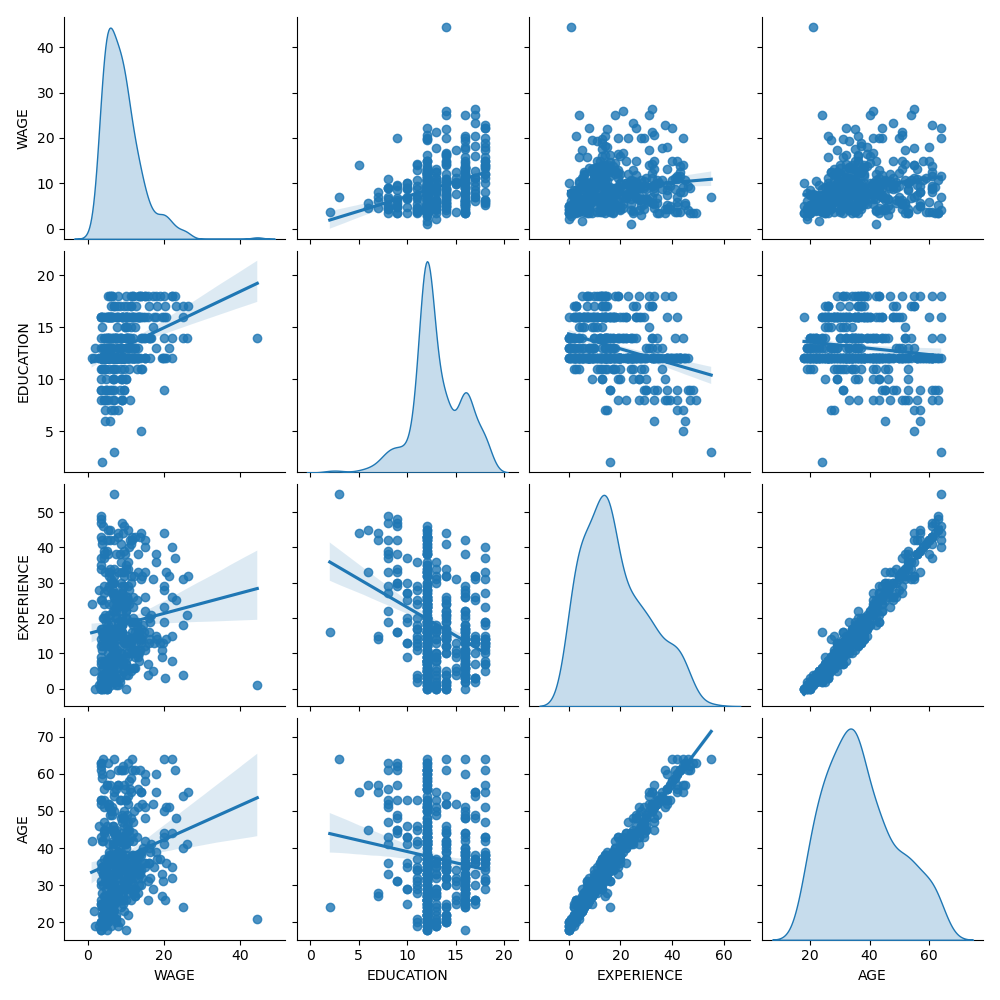
仔细观察 WAGE 分布会发现它有一个长尾。因此,我们应该对其取对数,使其近似为正态分布(岭或 Lasso 等线性模型最适用于误差的正态分布)。
WAGE 随 EDUCATION 的增加而增加。请注意,此处表示的 WAGE 和 EDUCATION 之间的依赖性是边际依赖性,即它描述了特定变量的行为,而没有固定其他变量。
此外,EXPERIENCE 和 AGE 之间存在很强的线性相关性。
机器学习管道#
为了设计我们的机器学习管道,我们首先手动检查我们正在处理的数据类型
survey.data.info()
<class 'pandas.core.frame.DataFrame'>
RangeIndex: 534 entries, 0 to 533
Data columns (total 10 columns):
 #   Column      Non-Null Count  Dtype
---  ------      --------------  -----
 0   EDUCATION   534 non-null    int64
 1   SOUTH       534 non-null    category
 2   SEX         534 non-null    category
 3   EXPERIENCE  534 non-null    int64
 4   UNION       534 non-null    category
 5   AGE         534 non-null    int64
 6   RACE        534 non-null    category
 7   OCCUPATION  534 non-null    category
 8   SECTOR      534 non-null    category
 9   MARR        534 non-null    category
dtypes: category(7), int64(3)
memory usage: 17.3 KB
如前所述,数据集包含具有不同数据类型的列,我们需要对每种数据类型应用特定的预处理。特别是,如果分类变量未首先编码为整数,则不能将其包含在线性模型中。此外,为了避免分类特征被视为有序值,我们需要对其进行独热编码。我们的预处理器将
对分类列进行独热编码(即,按类别生成一列),仅适用于非二进制分类变量;
作为第一种方法(我们稍后将看到数值归一化如何影响我们的讨论),保持数值不变。
from sklearn.compose import make_column_transformer
from sklearn.preprocessing import OneHotEncoder

categorical_columns = ["RACE", "OCCUPATION", "SECTOR", "MARR", "UNION", "SEX", "SOUTH"]
numerical_columns = ["EDUCATION", "EXPERIENCE", "AGE"]

preprocessor = make_column_transformer(
    (OneHotEncoder(drop="if_binary"), categorical_columns),
    remainder="passthrough",
    verbose_feature_names_out=False,  # avoid to prepend the preprocessor names
)
我们使用具有非常小正则化的岭回归器来模拟 WAGE 的对数。
from sklearn.compose import TransformedTargetRegressor
from sklearn.linear_model import Ridge
from sklearn.pipeline import make_pipeline

model = make_pipeline(
    preprocessor,
    TransformedTargetRegressor(
        regressor=Ridge(alpha=1e-10), func=np.log10, inverse_func=sp.special.exp10
    ),
)
处理数据集#
首先,我们拟合模型。
model.fit(X_train, y_train)
然后,我们通过绘制其预测值与测试集上的实际值,并计算中位数绝对误差,来检查计算模型的性能。
from sklearn.metrics import PredictionErrorDisplay, median_absolute_error

mae_train = median_absolute_error(y_train, model.predict(X_train))
y_pred = model.predict(X_test)
mae_test = median_absolute_error(y_test, y_pred)
scores = {
    "MedAE on training set": f"{mae_train:.2f} $/hour",
    "MedAE on testing set": f"{mae_test:.2f} $/hour",
}
_, ax = plt.subplots(figsize=(5, 5))
display = PredictionErrorDisplay.from_predictions(
    y_test, y_pred, kind="actual_vs_predicted", ax=ax, scatter_kwargs={"alpha": 0.5}
)
ax.set_title("Ridge model, small regularization")
for name, score in scores.items():
    ax.plot([], [], " ", label=f"{name}: {score}")
ax.legend(loc="upper left")
plt.tight_layout()
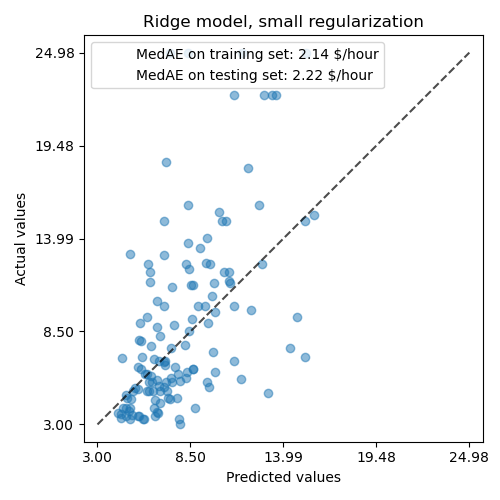
所学的模型远不是一个能做出准确预测的好模型:从上面的图中可以看出这一点,好的预测应该位于黑色虚线上。
在以下部分中,我们将解释模型的系数。在此过程中,我们应牢记,我们得出的任何结论都与我们构建的模型有关,而不是与数据的真实(现实世界)生成过程有关。
解释系数:量级很重要#
首先,我们可以看一下我们拟合的回归器的系数值。
feature_names = model[:-1].get_feature_names_out()

coefs = pd.DataFrame(
    model[-1].regressor_.coef_,
    columns=["Coefficients"],
    index=feature_names,
)

coefs
AGE 系数以“美元/小时/生命年”表示,而 EDUCATION 系数以“美元/小时/受教育年限”表示。这种系数表示的好处在于清楚地说明了模型的实际预测:AGE 增加 \(1\) 年意味着美元/小时减少 \(0.030867\),而 EDUCATION 增加 \(1\) 年意味着美元/小时增加 \(0.054699\)。另一方面,分类变量(如 UNION 或 SEX)是取值 0 或 1 的无量纲数字。它们的系数以美元/小时表示。因此,我们不能比较不同系数的大小,因为特征具有不同的自然尺度和值范围,因为它们的度量单位不同。如果我们将系数绘图,这会更明显。
coefs.plot.barh(figsize=(9, 7))
plt.title("Ridge model, small regularization")
plt.axvline(x=0, color=".5")
plt.xlabel("Raw coefficient values")
plt.subplots_adjust(left=0.3)
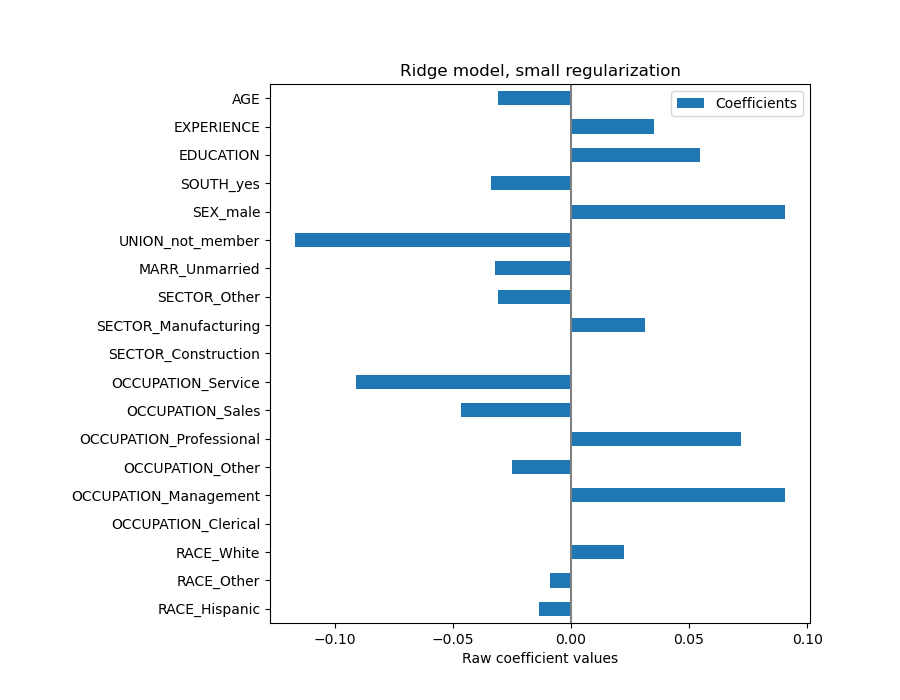
事实上,从上图中,决定 WAGE 最重要的因素似乎是变量 UNION,即使我们的直觉可能告诉我们 EXPERIENCE 等变量应该有更大的影响。
通过查看系数图来衡量特征重要性可能会产生误导,因为其中一些变量变化范围很小,而另一些变量,如 AGE,变化范围则大得多,长达数十年。
如果我们比较不同特征的标准差,这一点就很明显。
X_train_preprocessed = pd.DataFrame(
    model[:-1].transform(X_train), columns=feature_names
)

X_train_preprocessed.std(axis=0).plot.barh(figsize=(9, 7))
plt.title("Feature ranges")
plt.xlabel("Std. dev. of feature values")
plt.subplots_adjust(left=0.3)
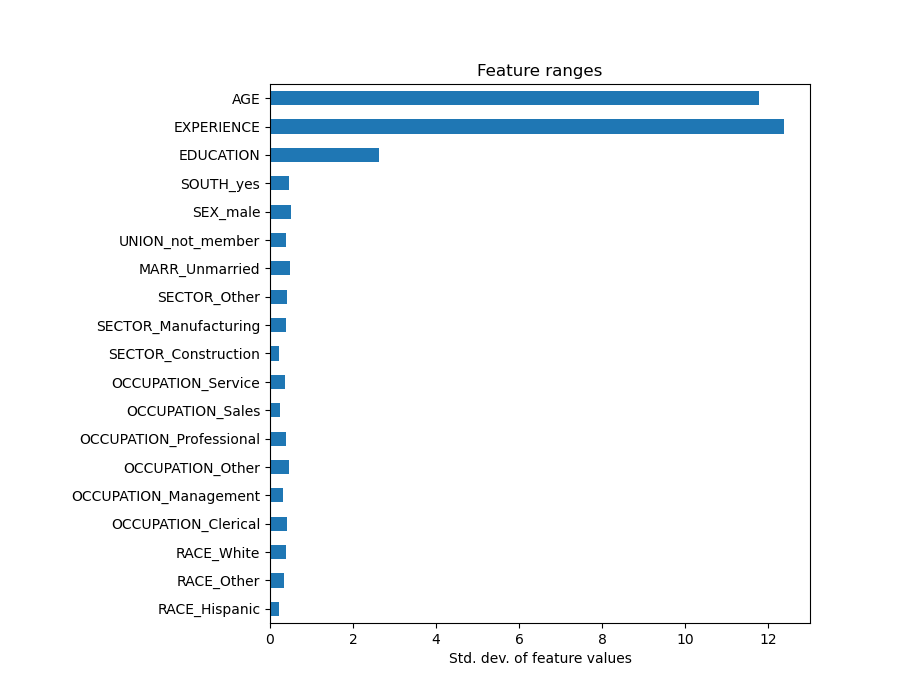
将系数乘以相关特征的标准差将使所有系数都减小到相同的度量单位。正如我们稍后将看到的,这等效于将数值变量归一化到其标准差,如 \(y = \sum{coef_i \times X_i} = \sum{(coef_i \times std_i) \times (X_i / std_i)}\)。
这样,我们强调在所有条件相同的情况下,特征的方差越大,相应系数对输出的影响就越大。
coefs = pd.DataFrame(
    model[-1].regressor_.coef_ * X_train_preprocessed.std(axis=0),
    columns=["Coefficient importance"],
    index=feature_names,
)
coefs.plot(kind="barh", figsize=(9, 7))
plt.xlabel("Coefficient values corrected by the feature's std. dev.")
plt.title("Ridge model, small regularization")
plt.axvline(x=0, color=".5")
plt.subplots_adjust(left=0.3)
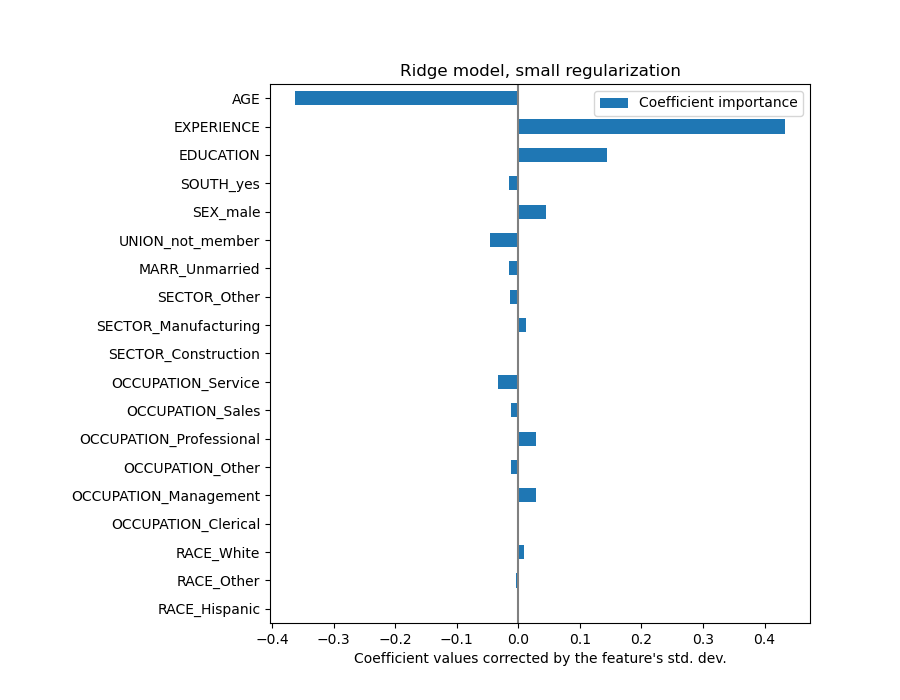
现在系数已经缩放,我们可以安全地比较它们了。
注意
为什么上图表明年龄的增加会导致工资的下降?为什么最初的成对图却显示相反的情况?这种差异是边际依赖和条件依赖之间的差异。
上图告诉我们特定特征与目标之间的依赖关系,当所有其他特征保持不变时,即 **条件依赖关系**。当所有其他特征保持不变时,AGE 的增加会导致 WAGE 的减少。相反,当所有其他特征保持不变时,EXPERIENCE 的增加会导致 WAGE 的增加。此外,AGE、EXPERIENCE 和 EDUCATION 是对模型影响最大的三个变量。
解释系数:警惕因果关系#
线性模型是衡量统计关联的强大工具,但我们在做出关于因果关系的陈述时应保持谨慎,毕竟相关性并不总是意味着因果关系。这在社会科学中尤其困难,因为我们观察到的变量仅作为潜在因果过程的代理。
在我们的特定案例中,我们可以将个人的 EDUCATION 视为其职业能力的代理,这是我们感兴趣但无法观察到的真实变量。我们当然希望在学校待更长时间会增加技术能力,但也很有可能因果关系是反向的。也就是说,那些技术能力强的人倾向于在学校待更长时间。
雇主不太可能关心是哪种情况(或者两者兼有),只要他们仍然相信受过更多教育的人更适合这份工作,他们就会乐意支付更高的 WAGE。
当考虑某种干预形式时,例如政府对大学学位的补贴或鼓励个人接受高等教育的宣传材料,这种混杂效应就成了问题。这些措施的有用性可能最终被夸大,尤其是当混杂程度很强时。我们的模型预测每增加一年教育,每小时工资增加 \(0.054699\)。由于这种混杂,实际的因果效应可能较低。
检查系数的变异性#
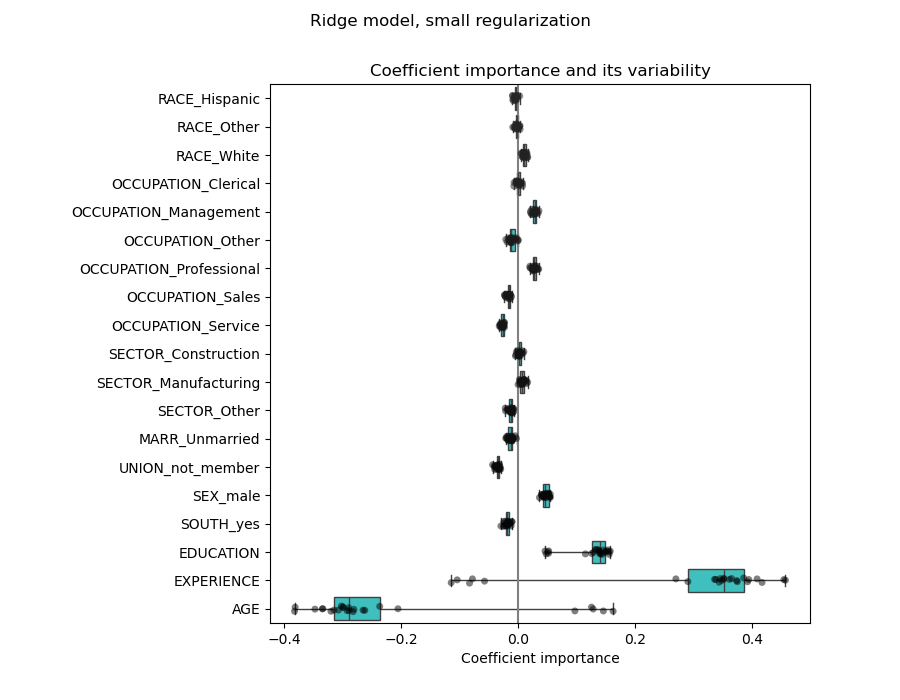
我们可以通过交叉验证来检查系数的变异性:这是一种数据扰动形式(与重采样有关)。
如果系数在更改输入数据集时显著变化,则不能保证其鲁棒性,并且可能应谨慎解释。
from sklearn.model_selection import RepeatedKFold, cross_validate

cv = RepeatedKFold(n_splits=5, n_repeats=5, random_state=0)
cv_model = cross_validate(
    model,
    X,
    y,
    cv=cv,
    return_estimator=True,
    n_jobs=2,
)

coefs = pd.DataFrame(
    [
        est[-1].regressor_.coef_ * est[:-1].transform(X.iloc[train_idx]).std(axis=0)
        for est, (train_idx, _) in zip(cv_model["estimator"], cv.split(X, y))
    ],
    columns=feature_names,
)
plt.figure(figsize=(9, 7))
sns.stripplot(data=coefs, orient="h", palette="dark:k", alpha=0.5)
sns.boxplot(data=coefs, orient="h", color="cyan", saturation=0.5, whis=10)
plt.axvline(x=0, color=".5")
plt.xlabel("Coefficient importance")
plt.title("Coefficient importance and its variability")
plt.suptitle("Ridge model, small regularization")
plt.subplots_adjust(left=0.3)
相关变量问题#
AGE 和 EXPERIENCE 系数受到强烈变异性的影响,这可能是由于这两个特征之间的共线性:由于 AGE 和 EXPERIENCE 在数据中一起变化,它们的影响很难区分。
为了验证这一解释,我们绘制了 AGE 和 EXPERIENCE 系数的变异性。
plt.xlabel("Age coefficient")
plt.ylabel("Experience coefficient")
plt.grid(True)
plt.xlim(-0.4, 0.5)
plt.ylim(-0.4, 0.5)
plt.scatter(coefs["AGE"], coefs["EXPERIENCE"])
_ = plt.title("Co-variations of coefficients for AGE and EXPERIENCE across folds")
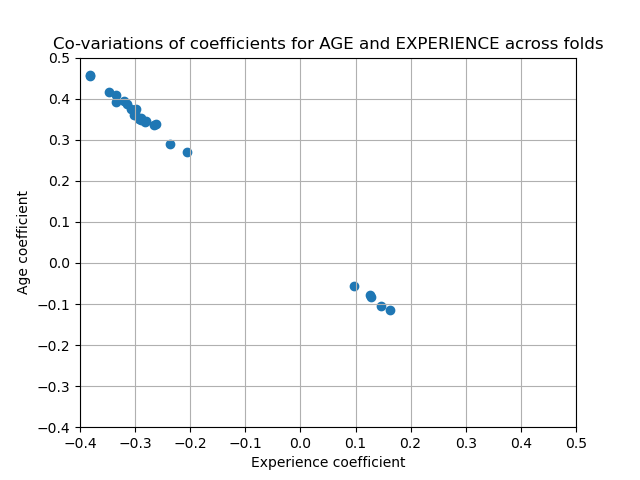
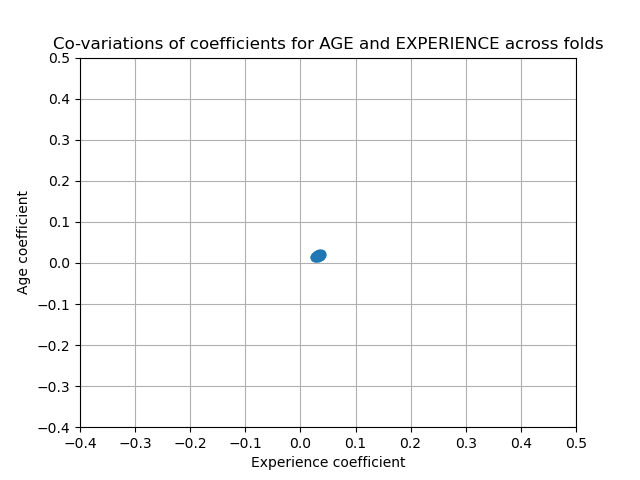
出现了两个区域:当 EXPERIENCE 系数为正时,AGE 系数为负,反之亦然。
为了进一步说明,我们删除其中一个特征 AGE,并检查对模型稳定性的影响。
column_to_drop = ["AGE"]

cv_model = cross_validate(
    model,
    X.drop(columns=column_to_drop),
    y,
    cv=cv,
    return_estimator=True,
    n_jobs=2,
)

coefs = pd.DataFrame(
    [
        est[-1].regressor_.coef_
        * est[:-1].transform(X.drop(columns=column_to_drop).iloc[train_idx]).std(axis=0)
        for est, (train_idx, _) in zip(cv_model["estimator"], cv.split(X, y))
    ],
    columns=feature_names[:-1],
)
plt.figure(figsize=(9, 7))
sns.stripplot(data=coefs, orient="h", palette="dark:k", alpha=0.5)
sns.boxplot(data=coefs, orient="h", color="cyan", saturation=0.5)
plt.axvline(x=0, color=".5")
plt.title("Coefficient importance and its variability")
plt.xlabel("Coefficient importance")
plt.suptitle("Ridge model, small regularization, AGE dropped")
plt.subplots_adjust(left=0.3)
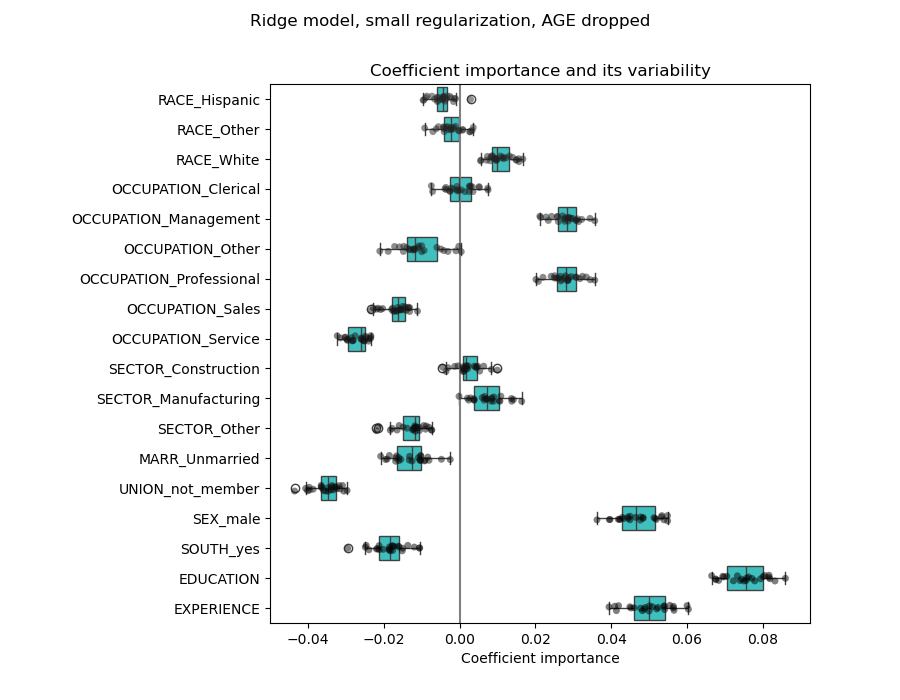
EXPERIENCE 系数的估计现在显示出大大降低的变异性。EXPERIENCE 在交叉验证期间训练的所有模型中仍然很重要。
预处理数值变量#
如上所述(参见“机器学习管道”),我们也可以选择在训练模型之前缩放数值。当我们在岭回归中对所有这些变量应用相似的正则化量时,这可能很有用。预处理器被重新定义,以便减去均值并将变量缩放为单位方差。
from sklearn.preprocessing import StandardScaler

preprocessor = make_column_transformer(
    (OneHotEncoder(drop="if_binary"), categorical_columns),
    (StandardScaler(), numerical_columns),
)
模型将保持不变。
model = make_pipeline(
    preprocessor,
    TransformedTargetRegressor(
        regressor=Ridge(alpha=1e-10), func=np.log10, inverse_func=sp.special.exp10
    ),
)
model.fit(X_train, y_train)
同样,我们使用中位数绝对误差来检查计算模型的性能。
mae_train = median_absolute_error(y_train, model.predict(X_train))
y_pred = model.predict(X_test)
mae_test = median_absolute_error(y_test, y_pred)
scores = {
    "MedAE on training set": f"{mae_train:.2f} $/hour",
    "MedAE on testing set": f"{mae_test:.2f} $/hour",
}

_, ax = plt.subplots(figsize=(5, 5))
display = PredictionErrorDisplay.from_predictions(
    y_test, y_pred, kind="actual_vs_predicted", ax=ax, scatter_kwargs={"alpha": 0.5}
)
ax.set_title("Ridge model, small regularization")
for name, score in scores.items():
    ax.plot([], [], " ", label=f"{name}: {score}")
ax.legend(loc="upper left")
plt.tight_layout()
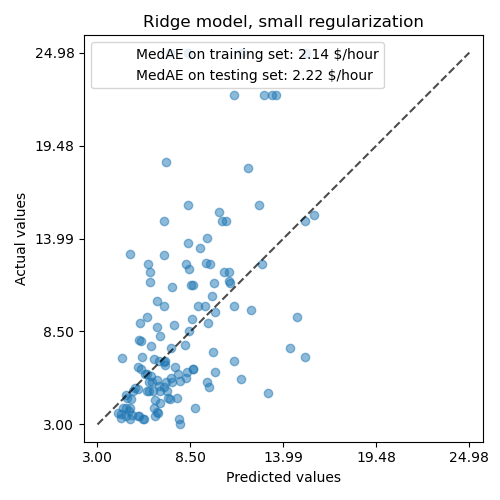
对于系数分析,这次不需要缩放,因为它已在预处理步骤中完成。
coefs = pd.DataFrame(
    model[-1].regressor_.coef_,
    columns=["Coefficients importance"],
    index=feature_names,
)
coefs.plot.barh(figsize=(9, 7))
plt.title("Ridge model, small regularization, normalized variables")
plt.xlabel("Raw coefficient values")
plt.axvline(x=0, color=".5")
plt.subplots_adjust(left=0.3)
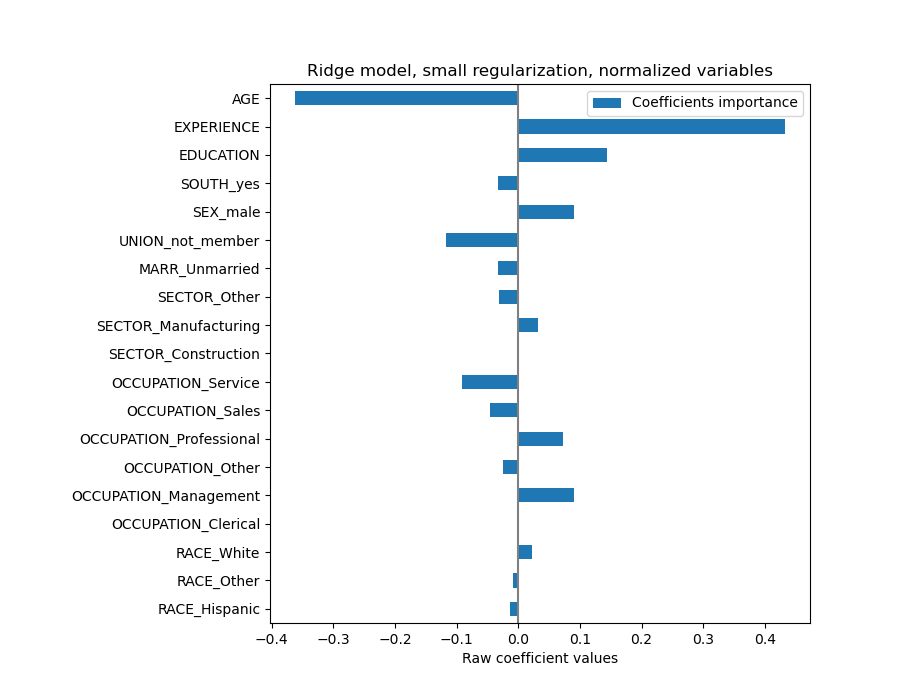
现在我们检查几个交叉验证折叠中的系数。
cv_model = cross_validate(
    model,
    X,
    y,
    cv=cv,
    return_estimator=True,
    n_jobs=2,
)
coefs = pd.DataFrame(
    [est[-1].regressor_.coef_ for est in cv_model["estimator"]], columns=feature_names
)
plt.figure(figsize=(9, 7))
sns.stripplot(data=coefs, orient="h", palette="dark:k", alpha=0.5)
sns.boxplot(data=coefs, orient="h", color="cyan", saturation=0.5, whis=10)
plt.axvline(x=0, color=".5")
plt.title("Coefficient variability")
plt.subplots_adjust(left=0.3)
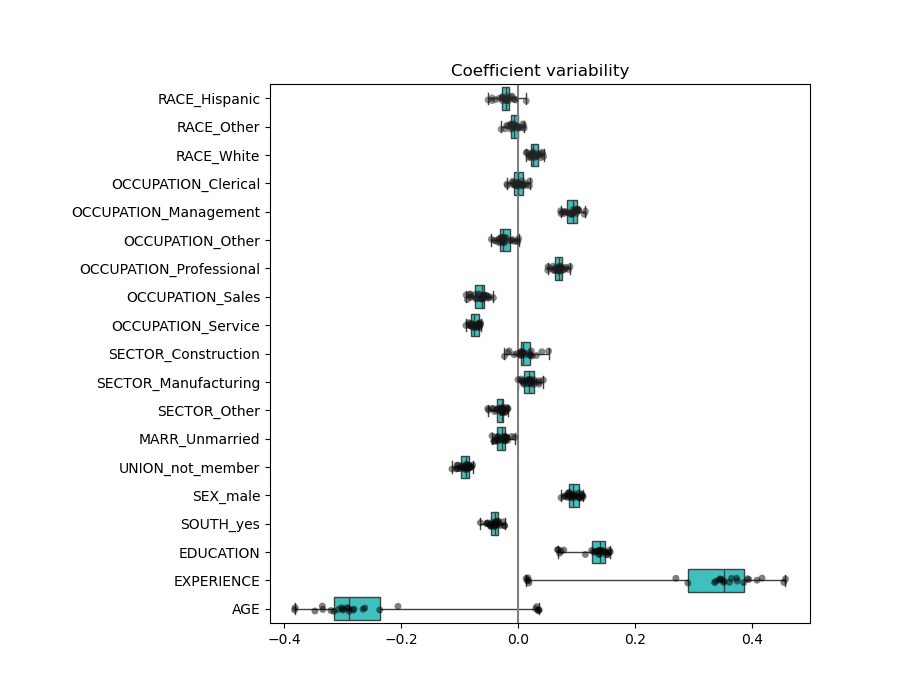
结果与未归一化的情况非常相似。
带正则化的线性模型#
在机器学习实践中,岭回归通常与不可忽略的正则化一起使用。
上面,我们将这种正则化限制在很小的量。正则化改善了问题的条件,并减少了估计的方差。RidgeCV 应用交叉验证以确定哪个正则化参数值(alpha)最适合预测。
from sklearn.linear_model import RidgeCV

alphas = np.logspace(-10, 10, 21)  # alpha values to be chosen from by cross-validation
model = make_pipeline(
    preprocessor,
    TransformedTargetRegressor(
        regressor=RidgeCV(alphas=alphas),
        func=np.log10,
        inverse_func=sp.special.exp10,
    ),
)
model.fit(X_train, y_train)
首先,我们检查选择了哪个 \(\alpha\) 值。
model[-1].regressor_.alpha_
10.0
然后我们检查预测的质量。
mae_train = median_absolute_error(y_train, model.predict(X_train))
y_pred = model.predict(X_test)
mae_test = median_absolute_error(y_test, y_pred)
scores = {
    "MedAE on training set": f"{mae_train:.2f} $/hour",
    "MedAE on testing set": f"{mae_test:.2f} $/hour",
}

_, ax = plt.subplots(figsize=(5, 5))
display = PredictionErrorDisplay.from_predictions(
    y_test, y_pred, kind="actual_vs_predicted", ax=ax, scatter_kwargs={"alpha": 0.5}
)
ax.set_title("Ridge model, optimum regularization")
for name, score in scores.items():
    ax.plot([], [], " ", label=f"{name}: {score}")
ax.legend(loc="upper left")
plt.tight_layout()
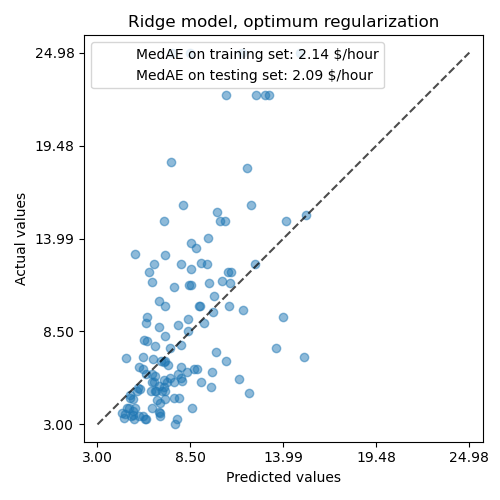
正则化模型重现数据的能力与非正则化模型相似。
coefs = pd.DataFrame(
    model[-1].regressor_.coef_,
    columns=["Coefficients importance"],
    index=feature_names,
)
coefs.plot.barh(figsize=(9, 7))
plt.title("Ridge model, with regularization, normalized variables")
plt.xlabel("Raw coefficient values")
plt.axvline(x=0, color=".5")
plt.subplots_adjust(left=0.3)
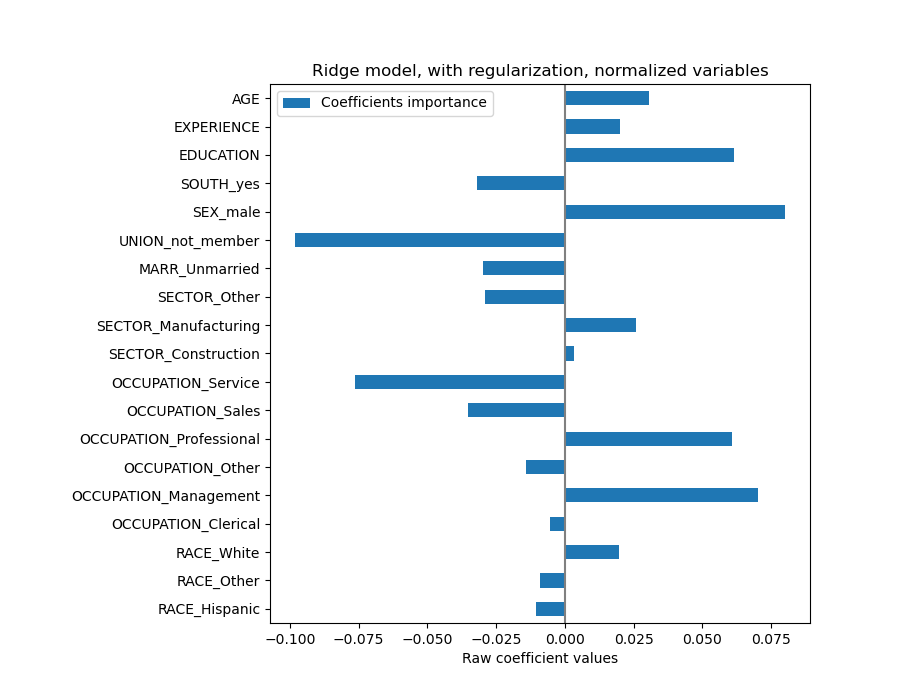
系数显著不同。AGE 和 EXPERIENCE 系数均为正,但它们对预测的影响现在较小。
正则化减少了相关变量对模型的影响,因为权重在两个预测变量之间共享,因此任何一个单独的变量都不会有很强的权重。
另一方面,通过正则化获得的权重更稳定(参见岭回归和分类用户指南部分)。从图中可以看出,这种增加的稳定性是通过交叉验证中的数据扰动获得的。此图可以与前一个图进行比较。
cv_model = cross_validate(
    model,
    X,
    y,
    cv=cv,
    return_estimator=True,
    n_jobs=2,
)
coefs = pd.DataFrame(
    [est[-1].regressor_.coef_ for est in cv_model["estimator"]], columns=feature_names
)
plt.xlabel("Age coefficient")
plt.ylabel("Experience coefficient")
plt.grid(True)
plt.xlim(-0.4, 0.5)
plt.ylim(-0.4, 0.5)
plt.scatter(coefs["AGE"], coefs["EXPERIENCE"])
_ = plt.title("Co-variations of coefficients for AGE and EXPERIENCE across folds")
具有稀疏系数的线性模型#
考虑数据集中相关变量的另一种可能性是估计稀疏系数。在某种程度上,我们已经在之前的岭回归估计中手动删除 AGE 列时做到了这一点。
Lasso 模型(参见Lasso用户指南部分)估计稀疏系数。LassoCV 应用交叉验证以确定哪个正则化参数值(alpha)最适合模型估计。
from sklearn.linear_model import LassoCV

alphas = np.logspace(-10, 10, 21)  # alpha values to be chosen from by cross-validation
model = make_pipeline(
    preprocessor,
    TransformedTargetRegressor(
        regressor=LassoCV(alphas=alphas, max_iter=100_000),
        func=np.log10,
        inverse_func=sp.special.exp10,
    ),
)

_ = model.fit(X_train, y_train)
首先,我们验证选择了哪个 \(\alpha\) 值。
model[-1].regressor_.alpha_
np.float64(0.001)
然后我们检查预测的质量。
mae_train = median_absolute_error(y_train, model.predict(X_train))
y_pred = model.predict(X_test)
mae_test = median_absolute_error(y_test, y_pred)
scores = {
    "MedAE on training set": f"{mae_train:.2f} $/hour",
    "MedAE on testing set": f"{mae_test:.2f} $/hour",
}

_, ax = plt.subplots(figsize=(6, 6))
display = PredictionErrorDisplay.from_predictions(
    y_test, y_pred, kind="actual_vs_predicted", ax=ax, scatter_kwargs={"alpha": 0.5}
)
ax.set_title("Lasso model, optimum regularization")
for name, score in scores.items():
    ax.plot([], [], " ", label=f"{name}: {score}")
ax.legend(loc="upper left")
plt.tight_layout()
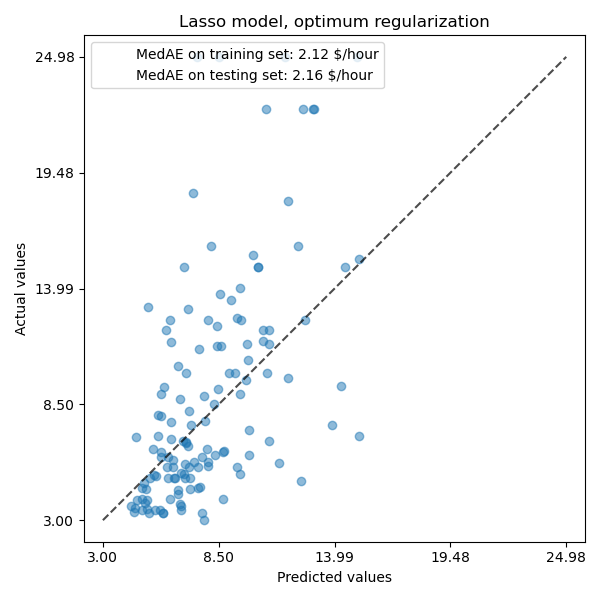
对于我们的数据集,该模型再次不具有很强的预测性。
coefs = pd.DataFrame(
    model[-1].regressor_.coef_,
    columns=["Coefficients importance"],
    index=feature_names,
)
coefs.plot(kind="barh", figsize=(9, 7))
plt.title("Lasso model, optimum regularization, normalized variables")
plt.axvline(x=0, color=".5")
plt.subplots_adjust(left=0.3)
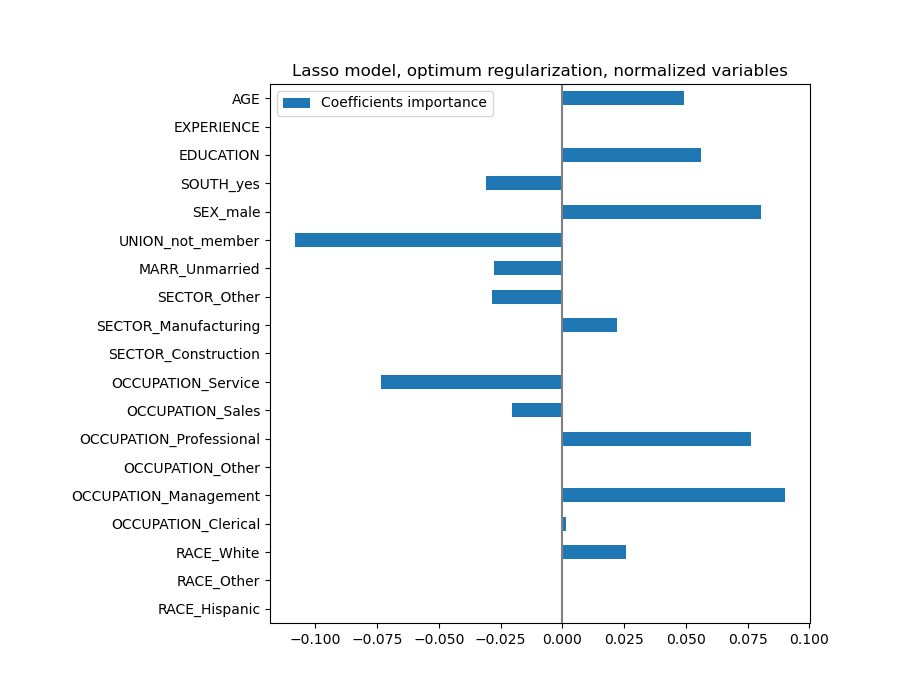
Lasso 模型识别 AGE 和 EXPERIENCE 之间的相关性,并为了预测而抑制其中一个。
重要的是要记住,被删除的系数本身可能仍然与结果相关:模型选择删除它们是因为除了其他特征之外,它们几乎没有或根本没有提供额外的信息。此外,这种选择对于相关特征是不稳定的,应谨慎解释。
事实上,我们可以检查系数在各折叠间的变异性。
cv_model = cross_validate(
    model,
    X,
    y,
    cv=cv,
    return_estimator=True,
    n_jobs=2,
)
coefs = pd.DataFrame(
    [est[-1].regressor_.coef_ for est in cv_model["estimator"]], columns=feature_names
)
plt.figure(figsize=(9, 7))
sns.stripplot(data=coefs, orient="h", palette="dark:k", alpha=0.5)
sns.boxplot(data=coefs, orient="h", color="cyan", saturation=0.5, whis=100)
plt.axvline(x=0, color=".5")
plt.title("Coefficient variability")
plt.subplots_adjust(left=0.3)
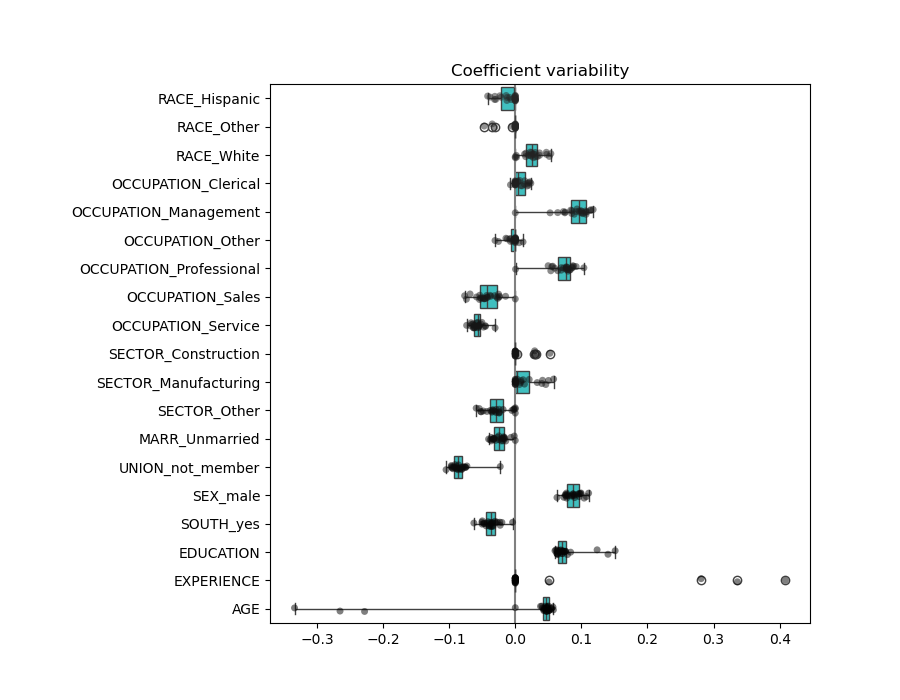
我们观察到 AGE 和 EXPERIENCE 系数根据折叠的不同而变化很大。
错误的因果解释#
政策制定者可能希望了解教育对工资的影响,以评估旨在吸引人们接受更多教育的某项政策是否具有经济意义。虽然机器学习模型在衡量统计关联方面表现出色,但它们通常无法推断因果效应。
人们可能很容易查看我们上一个模型(或任何模型)中教育对工资的系数,并得出结论认为它捕捉了标准化教育变量对工资变化的真实影响。
不幸的是,可能存在未观察到的混杂变量,这些变量会夸大或缩小该系数。混杂变量是同时导致 EDUCATION 和 WAGE 的变量。这种变量的一个例子是能力。据推测,能力更强的人更有可能接受教育,同时在任何教育水平下都更有可能获得更高的时薪。在这种情况下,能力对 EDUCATION 系数产生正的遗漏变量偏差(OVB),从而夸大了教育对工资的影响。
有关能力 OVB 的模拟案例,请参阅 机器学习未能推断因果效应。
经验教训#
系数必须缩放到相同的度量单位才能检索特征重要性。用特征的标准差缩放它们是一个有用的代理。
多元线性模型中的系数表示给定特征与目标之间的依赖关系,**以**其他特征为**条件**。
相关特征会导致线性模型系数的不稳定性,并且其影响无法很好地分离。
不同的线性模型对特征相关性的响应不同,并且系数可能彼此显著不同。
检查交叉验证循环各折叠中的系数可以了解它们的稳定性。
当存在混杂效应时,解释因果关系是困难的。如果两个变量之间的关系也受到某些未观察到的事物的影响,那么我们在做出关于因果关系的结论时应该小心。
脚本总运行时间: (0 分钟 9.893 秒)


相关示例